






Details
Description
Alexander van Bredael (Antwerp 1663 – 1720)
Allegory of Human Folly (Based on an Ancient Proverb)
Oil on canvas (71 …
Read more
Alexander van Bredael (Antwerp 1663 – 1720)
Allegory of Human Folly (Based on an Ancient Proverb)
Oil on canvas (71 x 97 cm. / Framed 90 x 121 cm.)
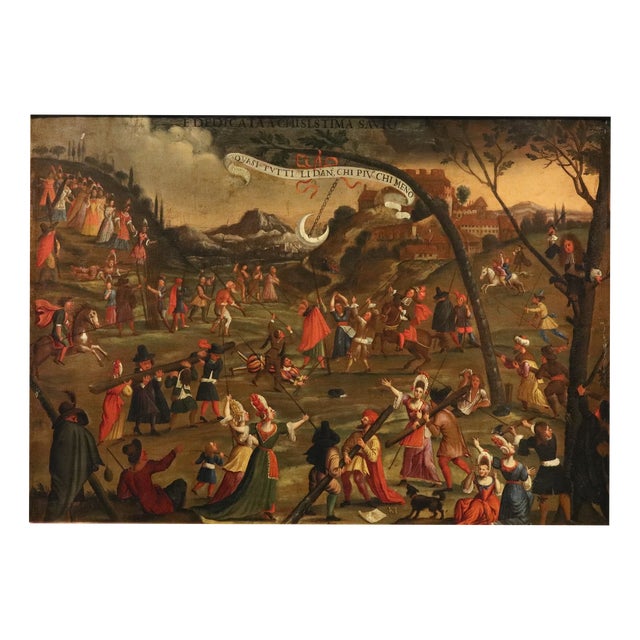
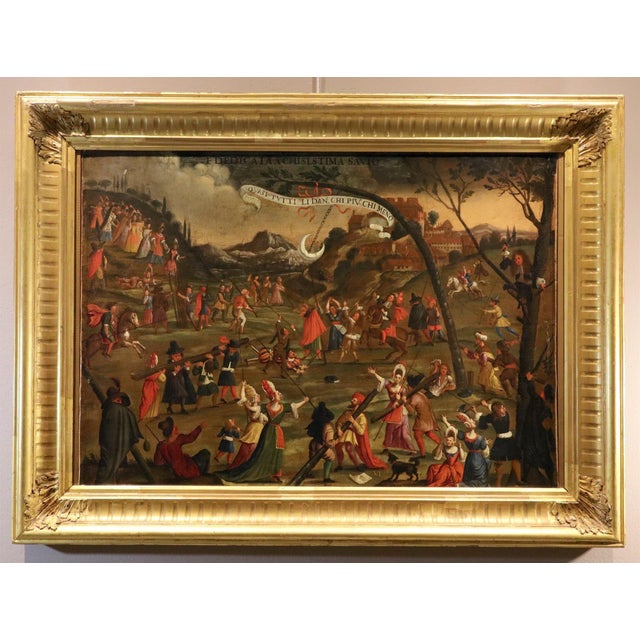
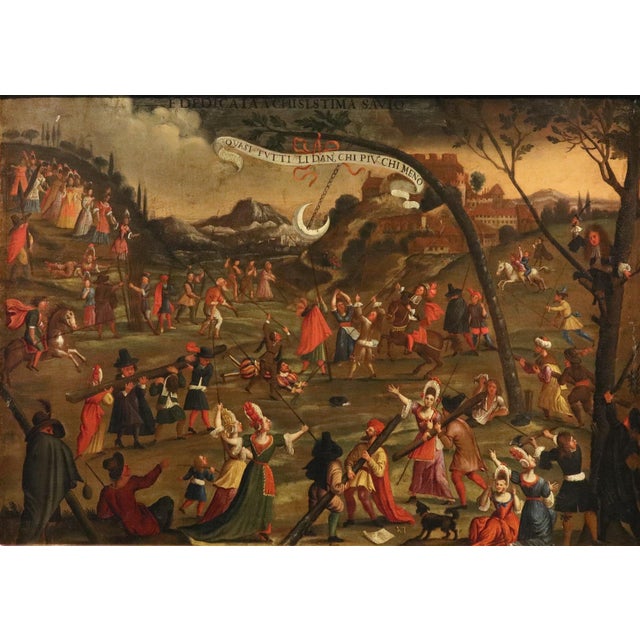
This fascinating painting with satirical and moralistic overtones, attributed to the Flemish artist Alexander van Bredael (Antwerp 1663 – 1720), is a poignant allegory of human folly and the illusion of wisdom.
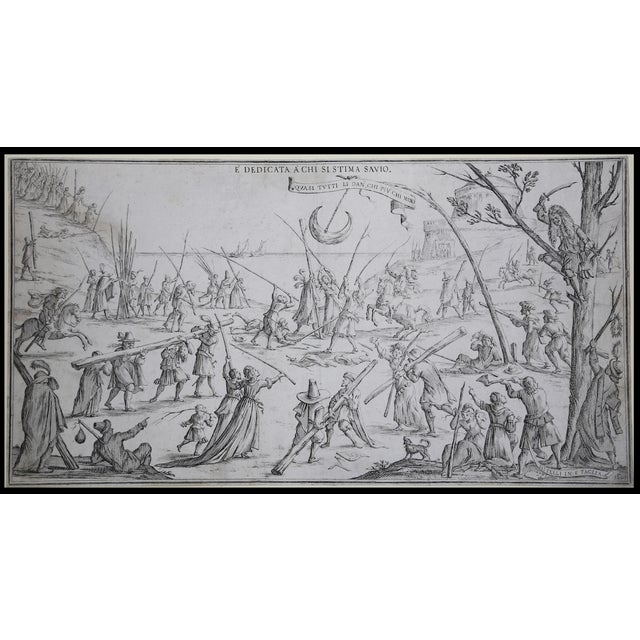
It is, more specifically, the transposition to canvas of a famous 1685 engraving by Giuseppe Maria Mitelli (Bologna 1634 – 1718), the author of a series of highly renowned popular prints based on the idea of giving visual form to popular sayings.
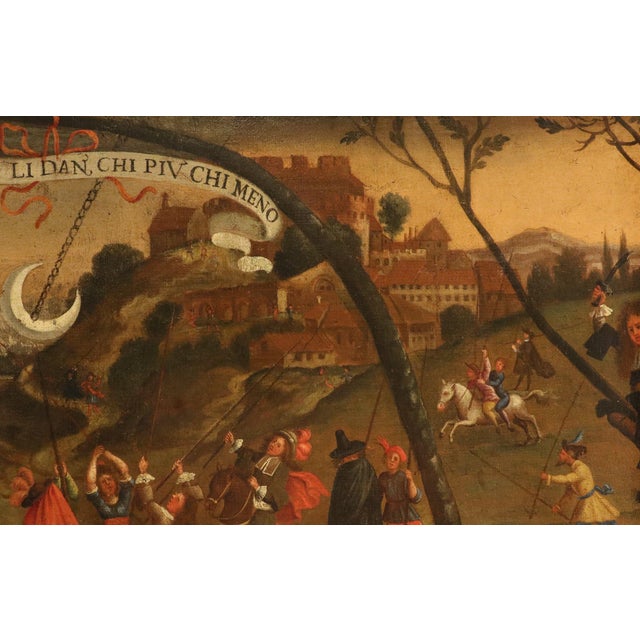
The conceptual core of the painting is evident in the two main inscriptions inherited from Mitelli's print, which also provide the work's title: the first, at the top, features the ironic dedication, "It is dedicated to those who consider themselves wise (or wise)," while in the center, on a cartouche, the inscription "Almost everyone gives them, some more, some less," satirically alluding to the indiscriminate blows of madness meted out to every human being, without exception.
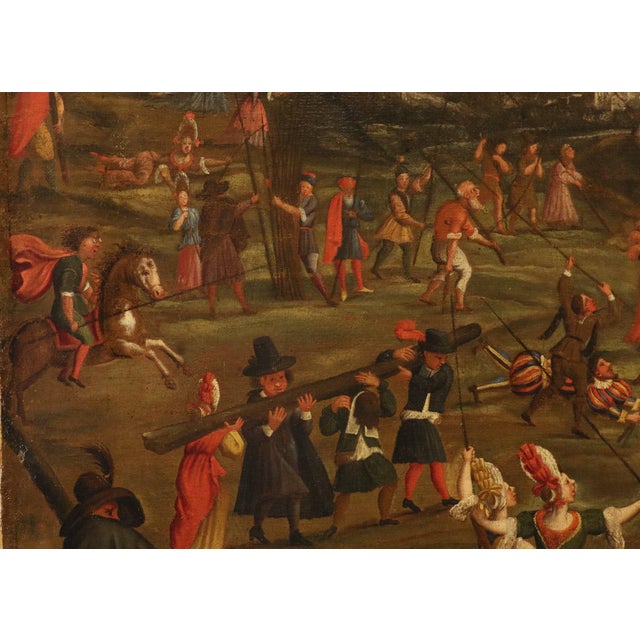
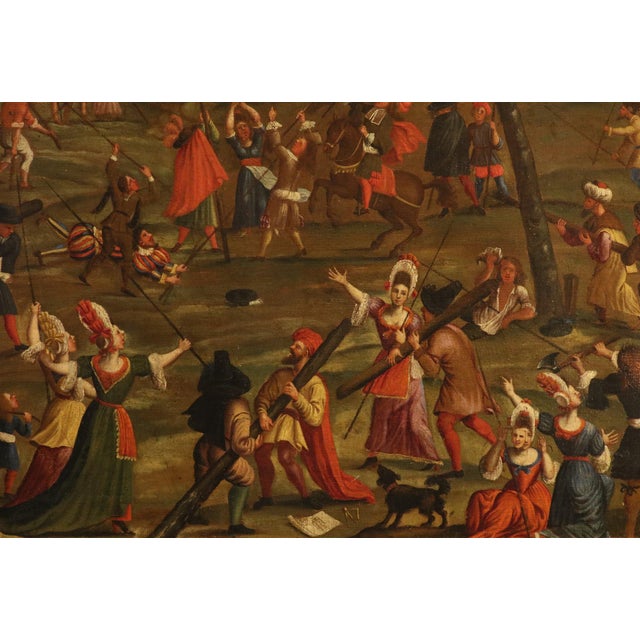
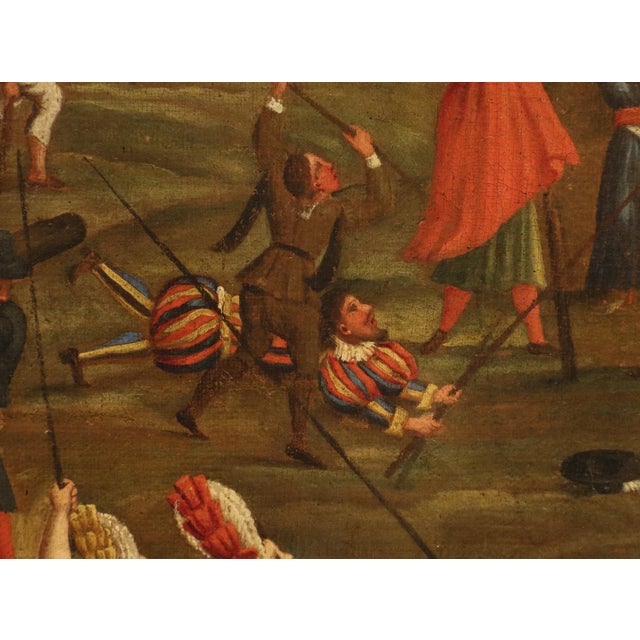
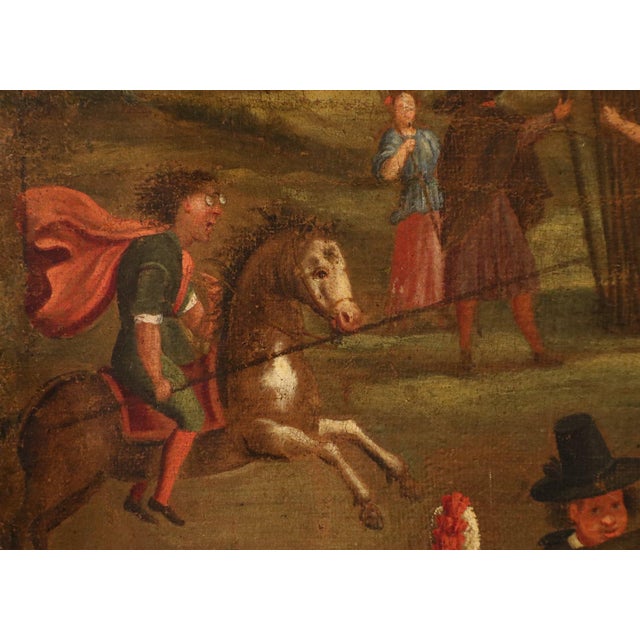
The scene, set in a hilly landscape dominated by a fortified fortress, is populated by a chaotic multitude of figures, men and women of all social classes, on foot and on horseback, rushing with poles, branches, and sticks, attempting to strike the simulacrum of a crescent moon (a traditional symbol of inconstancy and madness) hanging from a tree.
An entire book could be written to delve into the bizarre iconography of this painting, but we will limit ourselves, as far as possible, to analyzing its main aspects. We are faced with a complex composition, with numerous figures and allegorical symbols, which combine to suggest that all men, even those who consider themselves wisest, occasionally behave in a foolish or ridiculous manner.
Even today, the expression "to try to hit the moon with a stick" refers to someone trying to reach something infinitely distant with utterly inadequate means; it therefore means attempting an impossible and senseless feat, wasting one's strength.
In cultural and literary tradition, the moon has always been the universal symbol of madness, of human oddities and extravagances.
Beneath the moon moves a chaotic crowd of characters who argue, dance grotesquely, chase each other, and behave absurdly. No one is saved: life is a great performance in which madness touches each of us, "some more, some less," as the motto goes.
The work is dotted with mysterious and intriguing figures, each with a strong symbolic meaning, including: a woman wearing a mask (symbolizing falsehood or deception), a man beating his head with a stone (indicating the internal conflict he seeks to eradicate), and a man attempting to grasp a laurel wreath on a tree branch (alluding to the hunger for ambition). The men, then, laboriously advancing, carrying heavy logs on their backs, represent a metaphor for the absurd and arduous tasks imposed on man.
In the Flemish pictorial tradition, visual representations of proverbs and sayings of the time were highly fashionable as a way of reflecting on human follies (consider the series Pieter Bruegel dedicated to this theme), and many workshops, including that of the Van Bredaels, used prints and engravings as models for this purpose.
Collectors of the time (and in subsequent centuries) were obsessed with these paintings because they combined the fun of discovering absurd details with a profound moral lesson.
ADDITIONAL INFORMATION:
The painting is completed by a beautiful gold frame.
The work is sold with a certificate of authenticity and an iconographic . This piece is attributed to the mentioned designer/maker. It has no attribution mark and no
official proof of authenticity,
however it is well documented in design history. I take full responsibility for any authenticity
issues arising from misattribution
See less
- Dimensions
- 47.64ʺW × 4.72ʺD × 35.43ʺH
- Styles
- Baroque
- Art Subjects
- Figure
- Period
- 18th Century
- Country of Origin
- Italy
- Item Type
- Vintage, Antique or Pre-owned
- Condition
- Good Condition, Unknown, Some Imperfections
- Color
- Condition Notes
- Patina Consistent with Age and Use,Reupholstered,Partially Restored Patina Consistent with Age and Use,Reupholstered,Partially Restored less
Returns & Cancellations
Return Policy - All sales are final 48 hours after delivery, unless otherwise specified in the description of the product.
Cancellation Policy - Prior to shipping or local pickup, buyers may cancel an order for up to 48 hours, unless otherwise specified.
Related Collections
- Ed Ruscha Paintings
- Photorealism Canvas Paintings
- Ralph Lauren Paintings
- Photorealism Paintings in New York
- Silk Velvet Paintings
- Herman Miller Paintings
- Louise Nevelson Paintings
- Richard Serra Paintings
- Jaanika Peerna Paintings
- Jo Baskerville Paintings
- Jean-Paul Barray Paintings
- Hans Andersen Paintings
- Johannes Andersen Paintings
- Peter Behrens Paintings
- Raphael Paintings
- Photorealism Paintings in Los Angeles
- Carl-Axel Acking Paintings
- Joseph Stella Paintings
- Karl-Erik Ekselius Paintings
- Pedro Friedeberg Paintings
- Piet Hein Eek Paintings
- Black Photorealism Paintings
- Cassina Paintings
- James McCray Paintings
- Lawson-Fenning Paintings