

Details
Description
English Botanical Watercolor of Four Tulips, Flamed and Feathered Florists' Varieties
English, Early 19th Century
This early nineteenth-century English watercolor …
Read more
English Botanical Watercolor of Four Tulips, Flamed and Feathered Florists' Varieties
English, Early 19th Century
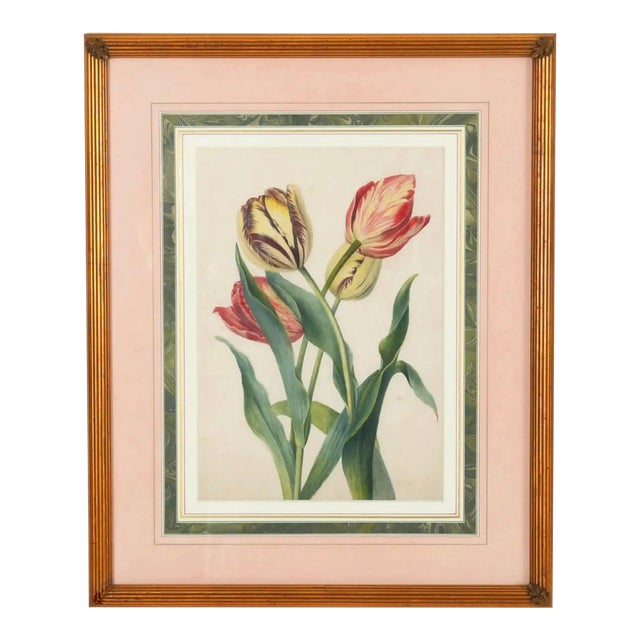
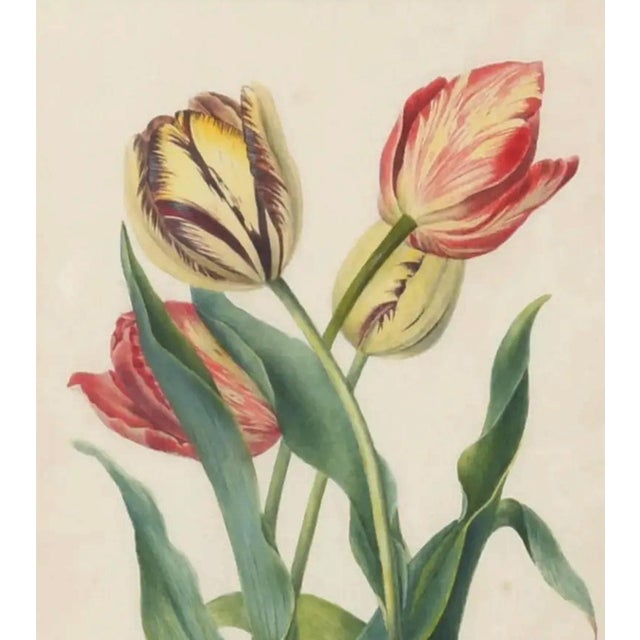
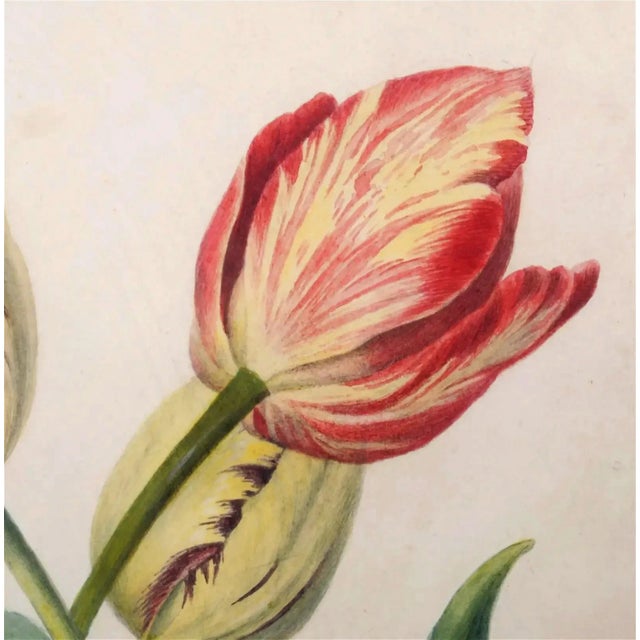
This early nineteenth-century English watercolor depicts four tulips, one a closed goblet, two opening and the fourth still furled, rising on long bare stems above a spray of tapering, ribbed leaves that anchors the composition, and set against the plain paper without a vase, ground line or cast shadow, in the manner of the florists' flower portraits of the period. The uppermost flower has a clear yellow ground flamed and feathered in maroon and near-black, the class the English florists called a bizarre; the flower to the right has a pale cream ground flamed in scarlet and rose, corresponding to the rose class; and the furled bud at the center shows the first maroon feathering breaking across a yellow-green ground. The fourth bloom, at the lower left, is a red tulip only lightly flushed with cream, nearest to the self-colored flowers the florists called breeders, from which a broken form was hoped for. Together the four record the range of coloring a single tulip bed of the period could produce.
The broken coloring is rendered in fine feathered strokes over pale transparent washes, while the leaves are laid in broader washes of blue-green and yellow-green with the ribs drawn in. The sheet is unsigned and the artist has not been identified; the hatched modeling belongs to the tradition of the flower painters on vellum of the seventeenth and eighteenth centuries, a manner kept up by trained miniaturists long after broader washes had become the rule among botanical illustrators.
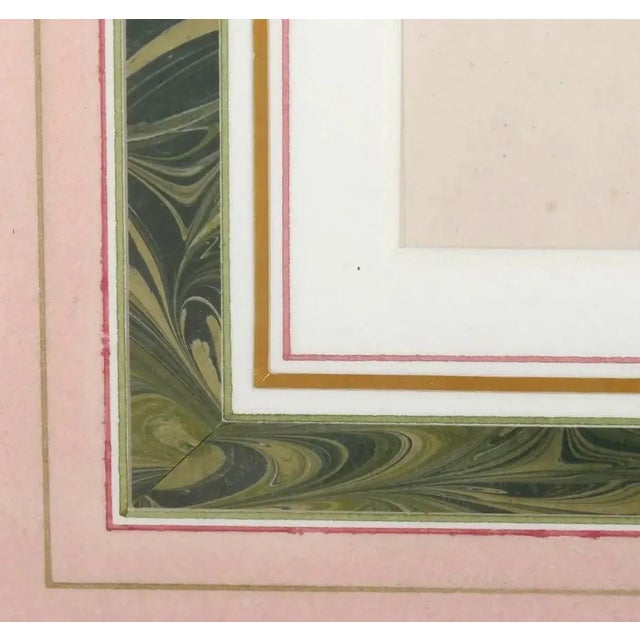
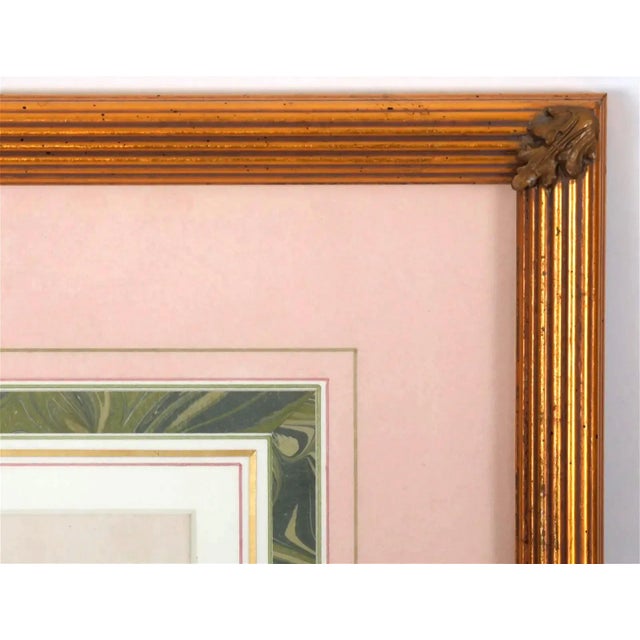
The watercolor is presented in a French mat with an inner cream mat ruled in gold and red, a band of green marbled paper and an outer pink mat with a further ruled border, within a gilt reeded frame with foliate corner blocks. It is the companion to the watercolor of seven tulips from the same source (NY10552-xicl), also available, with which it shares its manner of painting, its mat and its frame.
Hung with its companion sheet as a pair or alone above a chest or writing table, the watercolor suits a hall, bedroom or garden room, and the pink and green French mat sits comfortably with both traditional and painted interiors.
Dimensions (frame)
Height: 18 1/2 inches (47 cm)
Width: 15 inches (38.1 cm)
Depth: 1 inch (2.5 cm)
Marks
Unsigned. Gallery label of W. Graham Arader III on the reverse.
Provenance
W. Graham Arader III (gallery label)
Private Collection, Pennsylvania
Earle D. Vandekar of Knightsbridge
Condition
Good (to be confirmed in hand).
References
Maddock, James. The Florist's Directory; or a Treatise on the Culture of Flowers. London, 1792; later editions revised by Samuel Curtis, London, 1810 and 1822.
Thornton, Robert John. The Temple of Flora. London, 1799–1807, the plate of Tulips painted by Philip Reinagle and engraved by Richard Earlom, 1798.
Pavord, Anna. The Tulip. London: Bloomsbury, 1999.
Blunt, Wilfrid, and William T. Stearn. The Art of Botanical Illustration. London, 1950; revised edition, Woodbridge: Antique Collectors' Club, 1994.
Cayley, D. M. “‘Breaking’ in Tulips.” Annals of Applied Biology 15 (1928), pp. 529–539.
Historical Context
The early nineteenth century was the high point of the English florists' tulip. Growing and showing tulips, once the pursuit of wealthy collectors, had passed to tradesmen, artisans and gardeners, and tulip societies held annual shows in towns across the north and midlands of England, judging the flowers to strict standards of form and marking. The classes had been codified by James Maddock in The Florist's Directory of 1792: bizarres with a yellow ground marked in red, brown or black, bybloemens with a white ground marked in purple, and roses with a white ground marked in red or pink, each either feathered, with the color confined to the petal edges, or flamed, with a beam of color up the center of each petal as well.
The breaking that produced these patterns was proved in 1928 by Dorothy Cayley of the John Innes Horticultural Institution to be the work of an aphid-borne virus, but to contemporaries it remained a mysterious and much-desired transformation, and studies such as this served both as records of prized specimens and as decorative pictures in their own right. The English florists' tulip survives today in the Wakefield and North of England Tulip Society, founded in 1836.
See less
- Dimensions
- 15ʺW × 1ʺD × 18.5ʺH
- Frame Type
- Framed
- Art Subjects
- Botanic
- Period
- Early 19th Century
- Country of Origin
- United Kingdom
- Item Type
- Vintage, Antique or Pre-owned
- Materials
- Watercolor
- Condition
- Good Condition, Original Condition Unaltered, Some Imperfections
- Color
- Cream
- Condition Notes
- Good Good less
Questions about the item?
Returns & Cancellations
Return Policy - All sales are final 48 hours after delivery, unless otherwise specified in the description of the product.
Cancellation Policy - Prior to shipping or local pickup, buyers may cancel an order for up to 48 hours, unless otherwise specified.
Related Collections
- Ed Ruscha Paintings
- Photorealism Canvas Paintings
- Ralph Lauren Paintings
- Photorealism Paintings in New York
- Richard Serra Paintings
- Silk Velvet Paintings
- Black Photorealism Paintings
- Herman Miller Paintings
- Cassina Paintings
- Jaanika Peerna Paintings
- Photorealism Paintings in Los Angeles
- BDDW Paintings
- Jo Baskerville Paintings
- Jean-Paul Barray Paintings
- Hans Andersen Paintings
- Johannes Andersen Paintings
- Pedro Friedeberg Paintings
- Peter Behrens Paintings
- Piet Hein Eek Paintings
- Louise Nevelson Paintings
- Raphael Paintings
- Lee Reynolds Paintings
- Mid-Century Modern Paintings
- Abstract Paintings
- Nautical Paintings