

Details
Description
Dutch-Decorated English Creamware Plate, Onse Live Vrouw tot Kevelaar (Our Lady of Kevelaer)
Circa 1770–1790
This rare and historically resonant …
Read more
Dutch-Decorated English Creamware Plate, Onse Live Vrouw tot Kevelaar (Our Lady of Kevelaer)
Circa 1770–1790
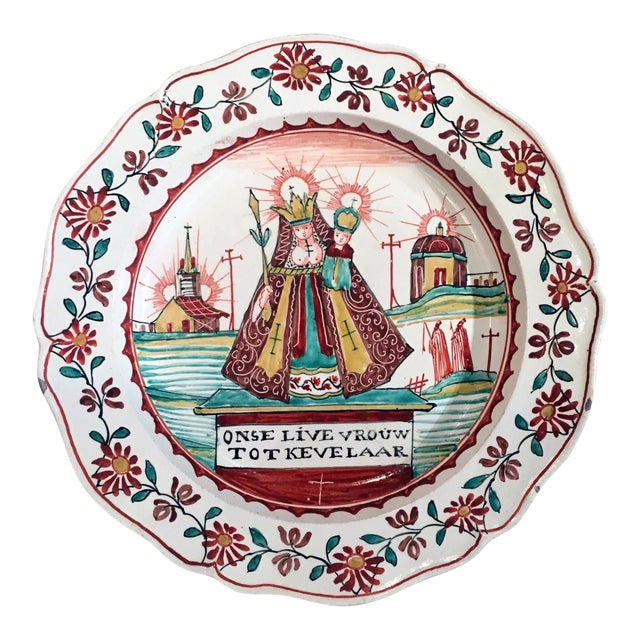
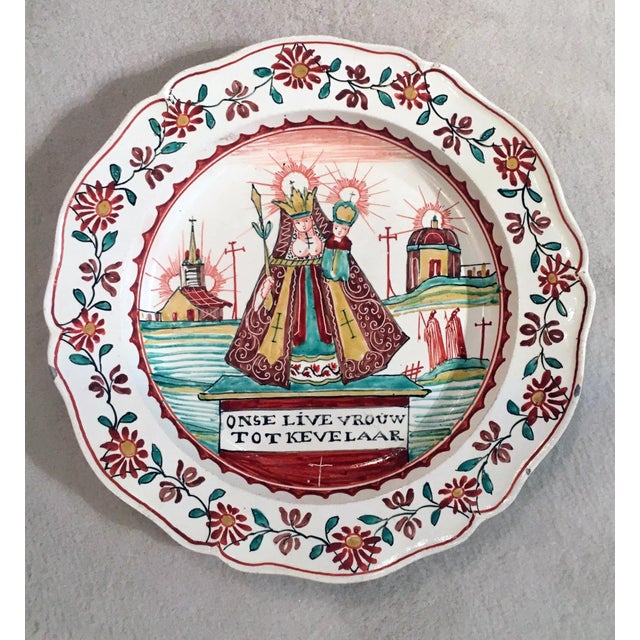
This rare and historically resonant creamware plate is of deep-well form with a shaped and lobed rim, the plain English blank having been exported to Holland and there decorated in polychrome enamels with a devotional subject of exceptional interest. The rim, edged with an iron-red line, is painted with a continuous trailing vine of stylized iron-red flowerheads with yellow centers and puce flower sprays among turquoise-green leaves on fine black stems. The well is framed by a double iron-red line and a band of iron-red scallops, and contains a vibrant hand-painted scene centered on the venerated image of Our Lady of Kevelaer.
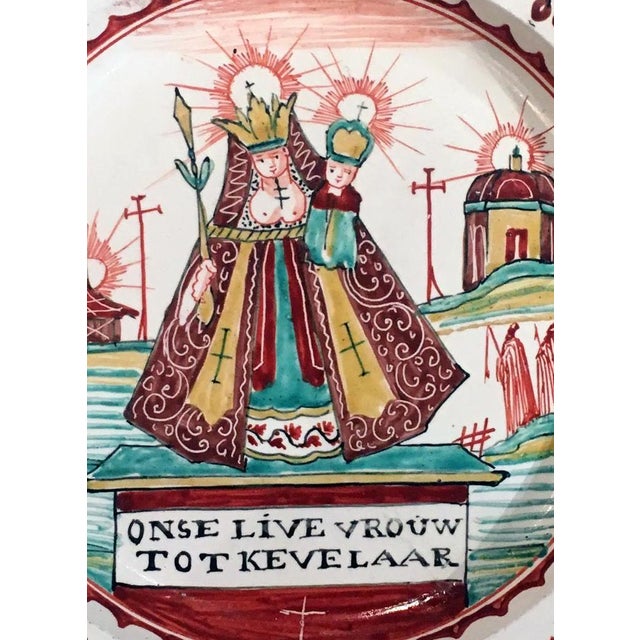
The Virgin and Child stand on a raised plinth, both crowned and shown frontally in the rigid, hieratic manner of the pilgrimage image, each crown topped by a small cross and set against a radiant halo of iron-red rays. The Virgin is enveloped in the stiff, bell-shaped mantle of the Luxembourg Madonna, painted in puce with white scrollwork and lined with yellow bands each bearing a green cross, over a turquoise gown with a flowered hem. Her bodice is painted open at the breast with a small cross at the throat, a liberty of the painter’s, since the shrine print shows a high, jeweled neckline. She holds a tall scepter in her right hand, and the Child, in a turquoise robe and puce cape, is held to her left side. Behind them, the low-lying landscape is suggested by bands of turquoise, green, and yellow beneath a sky streaked with iron-red. To the left rises a church with a tall spire beside a red-roofed building, and to the right stands a domed chapel with a lantern, both haloed with iron-red rays, while tall wayside crosses stand in the fields and two cloaked pilgrims with staffs, painted in red, approach from the right. The front of the plinth carries a white panel inscribed in Dutch capitals “ONSE LIVE VROUW / TOT KEVELAAR” (Our Lady of Kevelaer), above a red base marked with a small cross.
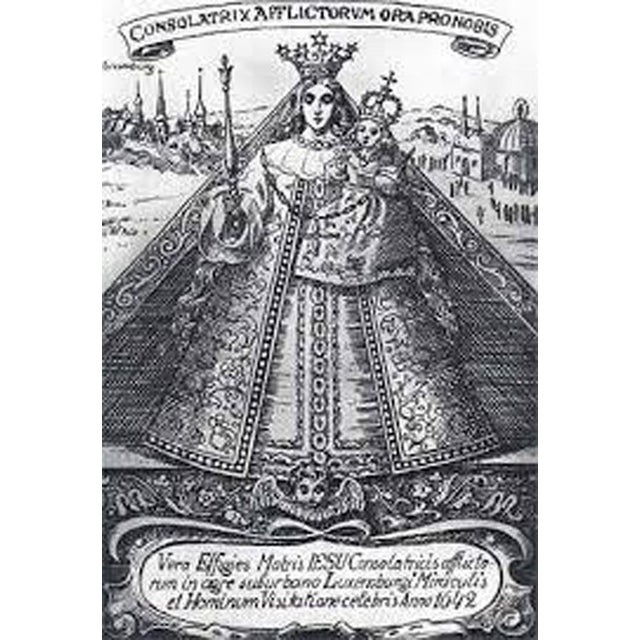
The painting is executed with the liveliness and directness typical of Dutch popular devotional ceramics, outlined in black and colored in iron-red, puce, turquoise-green, and yellow, with vigorous brushwork throughout. The composition closely follows the shrine’s own print: the scepter, the bell-shaped mantle, the Child at the Virgin’s left, the spired town to one side and the domed chapel with its pilgrims to the other, with the Dutch inscription taking the place of the print’s Latin cartouche.
The plate is best shown as a wall piece on a plate hanger, alone on a narrow wall or grouped with Delftware and other Dutch and English pottery, or on a stand in a cabinet. Its devotional subject also suits a library, study, or collection of religious and folk art.
Dimensions
Diameter: 10 inches (25.4 cm)
Height: 1¼ inches (3.2 cm)
Marks
Impressed numeral “4” on the reverse.
Provenance
Earle D. Vandekar of Knightsbridge
Condition
Painting in excellent condition with bright, strong colors. Star crack to the reverse; this does not penetrate through to the front.
References
Rijksmuseum, Amsterdam, inv. BK-NM-4221: creamware plate, England (possibly Liverpool), decorated in the Netherlands, circa 1780–1800, the cartouche inscribed “ONSE LIVEN VROU TOT KEVELAAR.”
Donald Towner, Creamware (London: Faber and Faber, 1978).
LVR-KuLaDig (Kultur.Landschaft.Digital), “Gnadenkapelle in Kevelaer,” record KLD-271055.
Historical Context
The shrine at Kevelaer, a small town in the Kleve district of North Rhine-Westphalia close to the Dutch border, has been one of the principal Catholic pilgrimage sites of northwestern Europe since 1642. According to tradition, the merchant Hendrick Busman, praying at a wayside cross shortly before Christmas 1641, in the last years of the Thirty Years’ War, heard a voice telling him to build a chapel there; his wife afterward saw in a vision the image it should hold, a small copperplate print of Our Lady of Luxembourg, the Consolatrix Afflictorum (Comforter of the Afflicted), whose cult the Jesuits had begun in Luxembourg in 1624. The print, probably made in Antwerp, was placed in a simple wayside shrine on June 1, 1642. The Kerzenkapelle, the first pilgrim church, followed in 1643–1645, and in 1654 the hexagonal Gnadenkapelle was built to enshrine the image, where it remains. Drawing pilgrims from the Netherlands and the German Rhineland in great numbers, Kevelaer became deeply rooted in the popular Catholic devotion of the Low Countries, and it still receives around a million visitors a year.
During the second half of the eighteenth century, English potters, particularly in Yorkshire and Staffordshire, exported plain creamware in quantity to the Netherlands, where independent decorating workshops painted it in enamels with subjects suited to Dutch and Flemish taste, among them religious, commemorative, and topographical scenes. Inscribed in Dutch, the present plate was evidently made as a souvenir or votive object for a Catholic pilgrim from the Netherlands. Its painter worked from the Kevelaer print itself, whose background shows the town of Luxembourg on one side and a domed chapel with a procession of pilgrims on the other, the Latin inscription describing the image as celebrated “in agro suburbano Luxemburgi” (in the fields outside Luxembourg). Pilgrimage plates are among the rarer survivals of the trade, and an example of the same subject is in the Rijksmuseum, Amsterdam. The impressed numeral “4” may denote a size or a workman’s tally rather than a factory mark, and no English factory attribution can be confirmed on present evidence.
(Ref: NY8799-iim)
See less
- Dimensions
- 10ʺW × 1ʺD × 10ʺH
- Period
- Late 18th Century
- Country of Origin
- United Kingdom
- Item Type
- Vintage, Antique or Pre-owned
- Materials
- Creamware
- Pottery
- Condition
- Good Condition, Original Condition Unaltered, Some Imperfections
- Color
- Cream
- Condition Notes
- Good - Moderate wear and tear, but still has good years left Good - Moderate wear and tear, but still has good years left less
Questions about the item?
Returns & Cancellations
Return Policy - All sales are final 48 hours after delivery, unless otherwise specified in the description of the product.
Cancellation Policy - Prior to shipping or local pickup, buyers may cancel an order for up to 48 hours, unless otherwise specified.
Related Collections
- Pickard China Decorative Plates
- Ox Bow Decor Decorative Plates
- Kenneth Ludwig Chicago Decorative Plates
- Tatiana Alida Decorative Plates
- Soapstone Decorative Plates
- Nickel Decorative Plates
- Silk Decorative Plates
- Copper Finish Decorative Plates
- Mixed-Media Decorative Plates
- Royal Stafford Decorative Plates
- Joseph Holdcroft Decorative Plates
- Tapio Wirkkala Decorative Plates
- Japanese Decorative Plates
- Chinese Decorative Plates
- Fruit Plates
- Brass Decorative Plates
- Spanish Decorative Plates
- Copper Decorative Plates
- Italian Decorative Plates
- Chinoiserie Decorative Plates
- Piero Fornasetti Decorative Plates
- Blue Decorative Plates
- Wedgwood Decorative Plates
- Green Decorative Plates
- Gold Decorative Plates