



Details
Description
English Creamware Sugar Caster or Pounce Shaker,
Circa 1775
This English creamware sugar caster is of baluster form, the full …
Read more
English Creamware Sugar Caster or Pounce Shaker,
Circa 1775
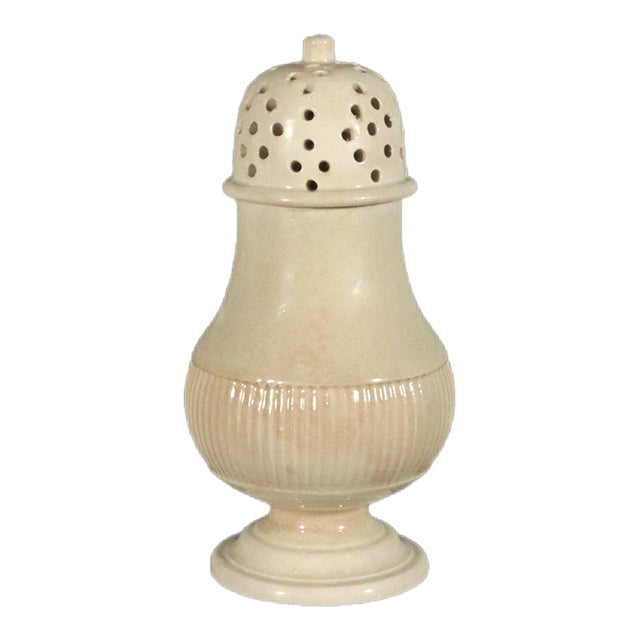
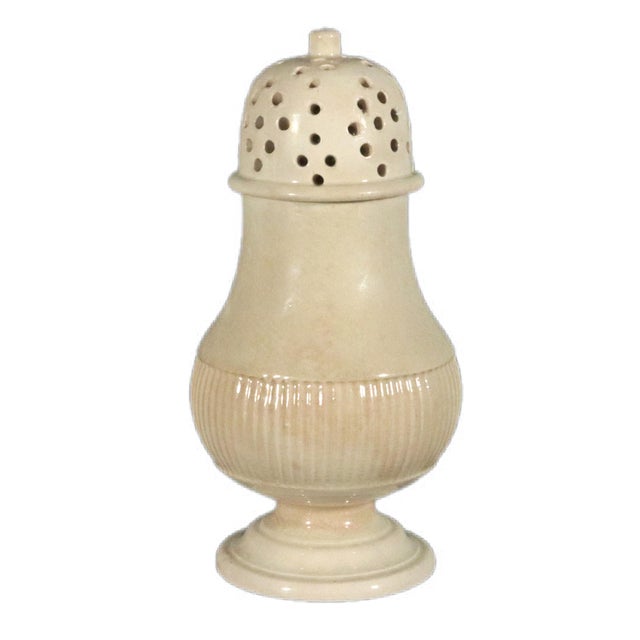
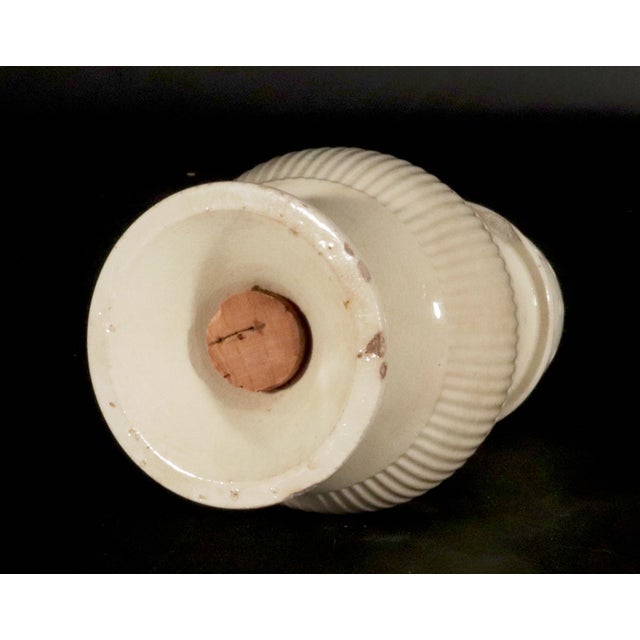
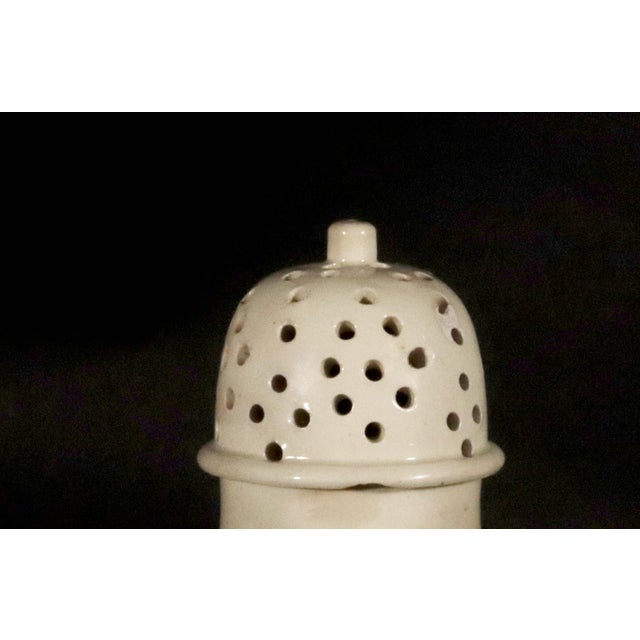
This English creamware sugar caster is of baluster form, the full lower body closely reeded, the reeds finishing in a neat scalloped edge below a plain upper body that tapers to a narrow cylindrical neck. It is raised on a short stem and a stepped, spreading circular foot. The high domed top, potted in one piece with the body and set off by a molded band at its base, is pierced with small circular holes in staggered rows and surmounted by a short stem finial. The underside carries a filling hole closed with a cork.
The piece is entirely undecorated, which is the point of it: the whole effect rests on the profile, the crispness of the reeding and the even, faintly honeyed glaze pooling between the reeds. Plain creamware of this quality was the everyday luxury of the late eighteenth-century English household, cheap enough to buy in quantity and fine enough to sit beside silver.
The form follows the silver sugar casters of the period and was made for the table, where it was used to sprinkle sugar over fruit, pastry and puddings. The same shape could equally serve on the writing desk to hold pounce, the fine powder of pumice, cuttlefish bone or gum sandarac that was rubbed into rough paper to stop the ink from feathering, or the sand that was shaken over wet ink to blot it before a letter was folded and sealed. Nothing about the object itself rules out either use, which is why pieces of this kind are catalogued under both names.
Displayed with other plain creamware on a dresser or open shelves, or set on a writing desk, it suits a traditional English interior as readily as a pared-back modern one, where its pale glaze and clean profile read almost as sculpture.
Dimensions
Height: 5½ inches (14.0 cm)
Diameter: 2¾ inches (7.0 cm)
Marks
Unmarked, as is usual for creamware of this date.
Provenance
Earle D. Vandekar of Knightsbridge
Historical Context
Cream-colored earthenware was the great English ceramic success of the later eighteenth century — light, thin, cheap to produce and clean in the hand — and it drove tin-glazed delftware off the English table within a generation. Josiah Wedgwood renamed his version Queen's Ware after Queen Charlotte's patronage in 1765, and the Staffordshire and Yorkshire potteries turned out the same repertoire of shapes in enormous quantity for home use and for export across Europe and America. Small desk and table wares of this kind survive in far smaller numbers than plates and dishes: they were used hard, they were easily knocked off a desk or table, and their pierced tops were always the most vulnerable part.
(Ref: NY10893-mrrx)
See less
- Dimensions
- 2.75ʺW × 2.75ʺD × 5.5ʺH
- Styles
- Shaker
- Period
- Late 18th Century
- Country of Origin
- United Kingdom
- Item Type
- Vintage, Antique or Pre-owned
- Materials
- Creamware
- Condition
- Good Condition, Original Condition Unaltered, Some Imperfections
- Color
- Cream
- Condition Notes
- Condition Good antique condition, the glaze bright and evenly toned with light crazing. Condition Good antique condition, the glaze bright and evenly toned with light crazing. less
Questions about the item?
Returns & Cancellations
Return Policy - All sales are final 48 hours after delivery, unless otherwise specified in the description of the product.
Cancellation Policy - Prior to shipping or local pickup, buyers may cancel an order for up to 48 hours, unless otherwise specified.
Related Collections
- Christian Dior Desk Sets
- Kalmar Desk Sets
- Desk Sets in Monterey, CA
- Medieval Desk Sets
- Malachite Desk Sets
- Amber Desk Sets
- Mexican Desk Sets
- Gothic Revival Desk Sets
- Antique Bronze Finish Desk Sets
- Mid-Century Modern Desk Sets
- Victorian Desk Sets
- Brass Desk Sets
- Roycroft Desk Sets
- Embossed Leather Desk Sets
- Spanish Desk Sets
- Neoclassical Revival Desk Sets
- Qing Desk Sets