







Details
Description
This exceptionally sophisticated black lacquer and brass-mounted commode by De Coene Frères is a striking example of the celebrated Belgian …
Read more
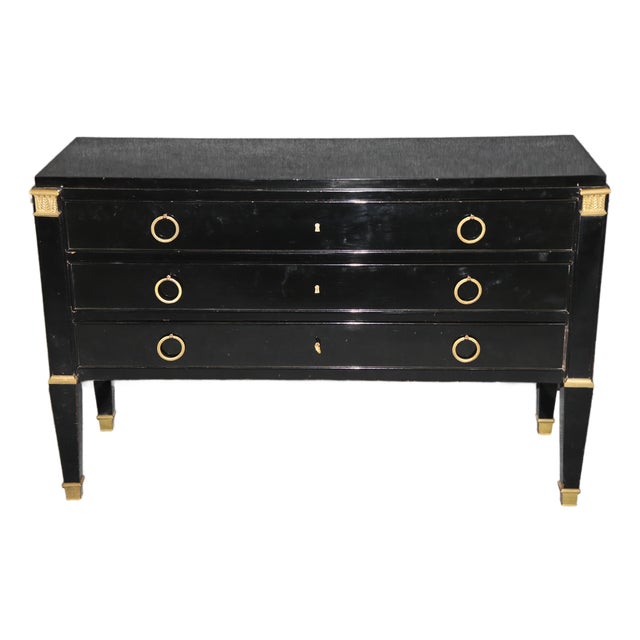
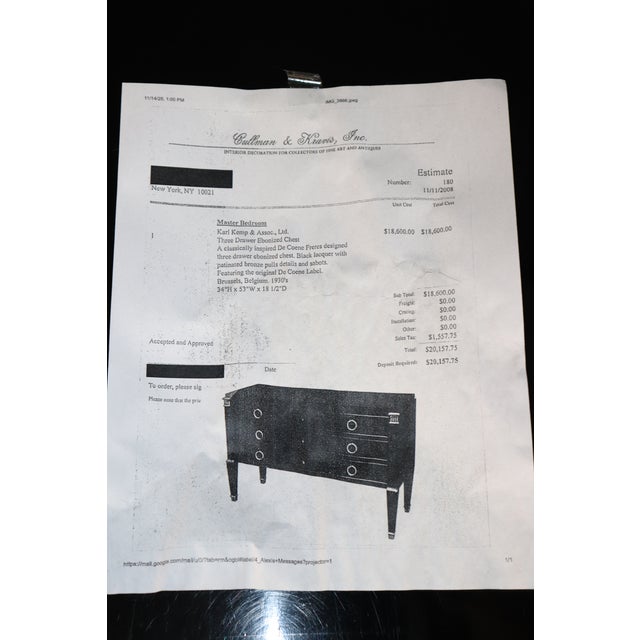
This exceptionally sophisticated black lacquer and brass-mounted commode by De Coene Frères is a striking example of the celebrated Belgian firm's ability to reinterpret historic French design through the refined lens of twentieth-century European decorative arts. Dating to approximately the 1930s, the commode draws heavily upon the restrained neoclassical vocabulary of the French Directoire period, yet its highly polished black surface, simplified architecture, and bold use of contrasting brass give it an unmistakably modern presence. A documented example matching this design is catalogued as a De Coene Frères Directoire-style commode of the 1930s, measuring approximately 34 inches high by 53 inches wide and 18½ inches deep.
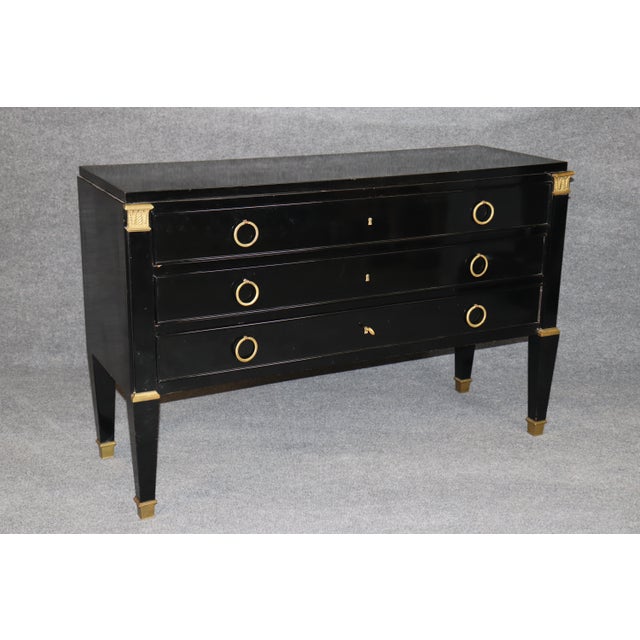
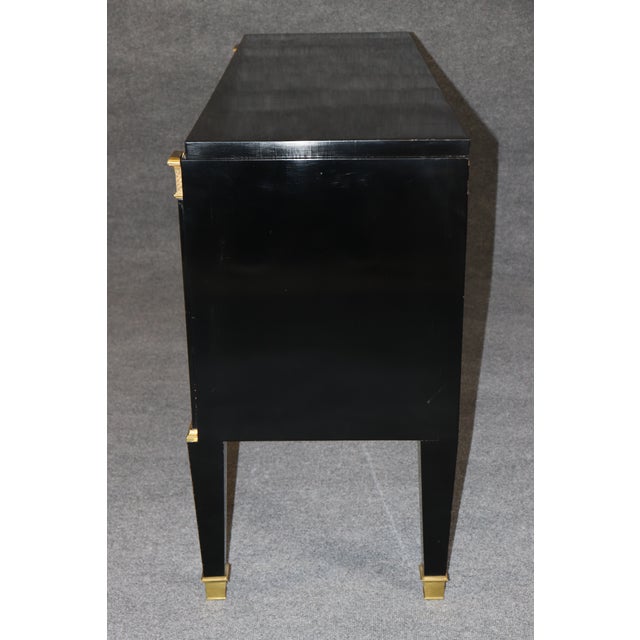
The cabinet is beautifully proportioned, with a long rectangular top above a restrained three-drawer façade. Its most immediate visual characteristic is the deep, lustrous black lacquered finish. The darkness of the case creates a dramatic background against which the restrained brass ornament appears almost jewel-like. Rather than covering the furniture with decoration, the designer has used metal sparingly and strategically—an approach entirely in keeping with the elegant severity associated with Directoire design.
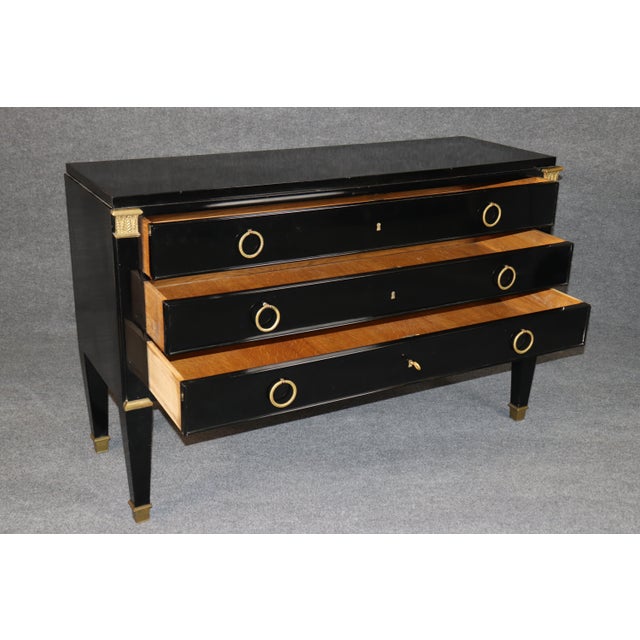
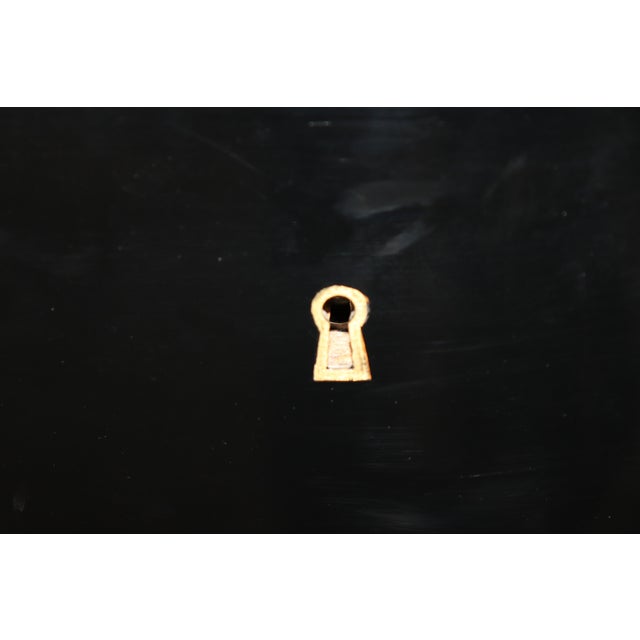
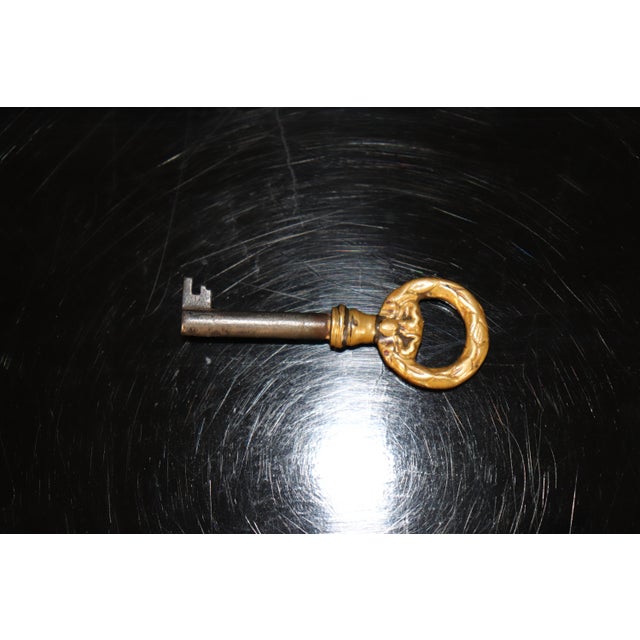
The uppermost drawer is broad and shallow, fitted with a pair of circular brass ring pulls positioned symmetrically to either side of a small central key escutcheon. Two deeper drawers below repeat the same arrangement, establishing a beautifully controlled rhythm across the otherwise unadorned black façade. The circular pulls are particularly effective: their pure geometric form introduces a classical element without disturbing the disciplined simplicity of the cabinet.
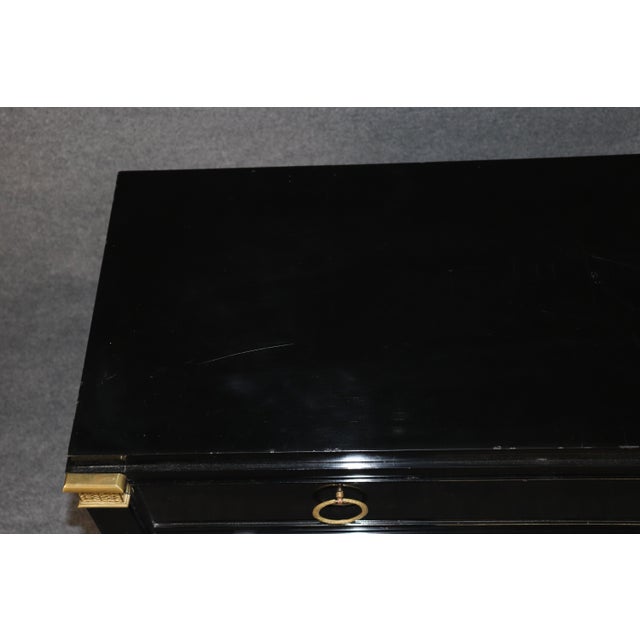
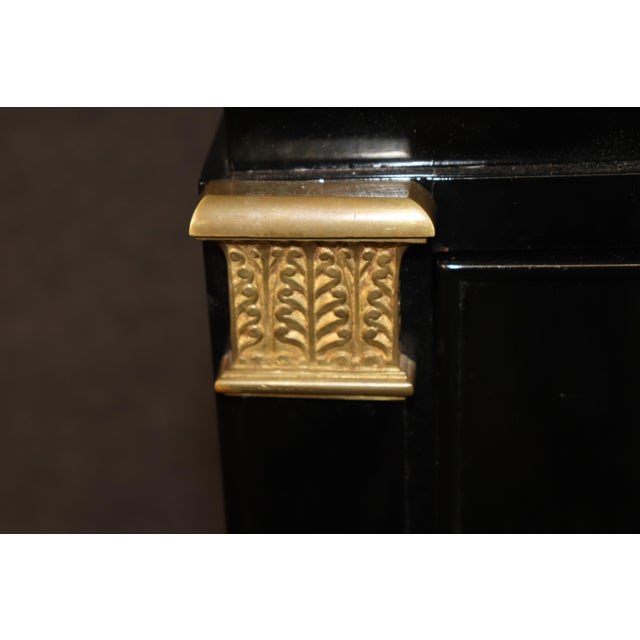
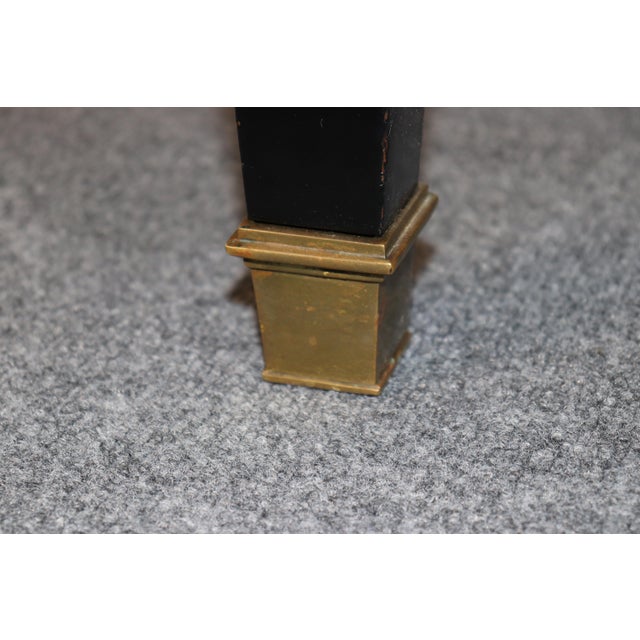
The outer corners are treated architecturally. Near the top, handsome rectangular brass capitals or mounts are decorated with a repeating neoclassical pattern. Narrow brass bands appear again near the transition between the cabinet and its legs, while each foot terminates in a neat brass shoe or sabot. These small flashes of gold against black provide exactly the degree of ornament necessary to articulate the structure.
Four tall, slightly tapering legs lift the substantial cabinet above the floor, giving it a remarkable sense of lightness. This elevated stance is fundamental to its Directoire character. Instead of the bombé sides, cabriole legs, floral marquetry, and exuberant ormolu associated with Louis XV furniture, this commode relies upon straight lines, geometric hardware, tapering supports, symmetry, and architectural restraint.
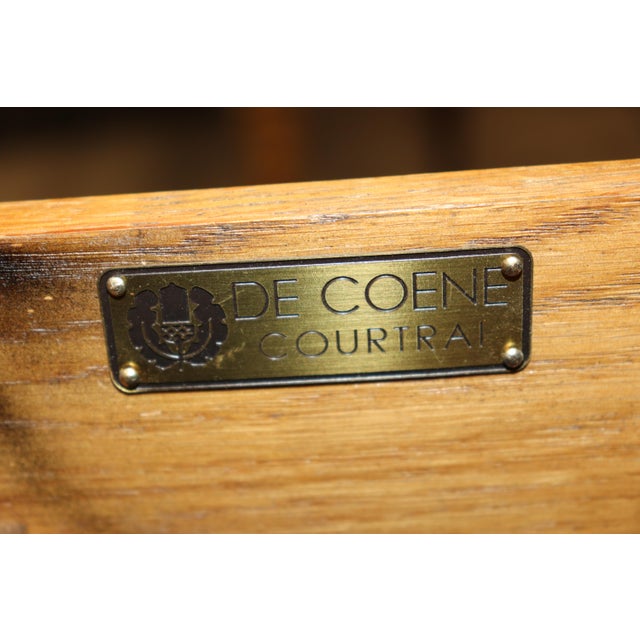
The maker is equally fascinating. De Coene Frères—roughly pronounced “duh KOON frair,” with Frères meaning “brothers” in French—was based in Kortrijk, Belgium, historically known in French as Courtrai. The enterprise developed from the De Coene family's decorating business, with brothers Jozef (Joseph) and Adolf De Coene playing central roles in transforming it into an important furniture and interior-design concern. The name De Coene Frères was formally adopted in 1905.
The firm was far more than an ordinary furniture manufacturer. From its early years it pursued the idea of the complete interior, bringing together furniture, upholstery, textiles, stained glass, lighting, marble and other decorative arts within unified schemes. Its early aesthetic was influenced by Henry van de Velde and the Arts and Crafts movement, and its workshops employed highly trained craftsmen across numerous disciplines.
De Coene became enormously important during the interwar period. At the celebrated 1925 Paris Exposition Internationale des Arts Décoratifs et Industriels Modernes—the exhibition from which the term Art Deco ultimately derives—the firm presented complete interiors and received a Grand Prix from the international jury. By 1929, at the height of its prewar success, its extensive workshops reportedly employed approximately 2,700 people, producing not only furniture but metalwork, upholstery, carpets, glass, marble work and lighting.
The company was also technically innovative. Following Jozef De Coene's 1921 journey to the United States, the firm became a pioneer in plywood production in Belgium, combining traditional cabinetmaking with increasingly sophisticated industrial methods. Its reputation extended to the highest levels of European patronage: the Henry van de Velde catalogue raisonné records De Coene as executing Van de Velde-designed furniture and carpets for King Leopold III of Belgium in 1935.
That history makes this commode particularly interesting. It demonstrates how De Coene could look backward to Directoire and French neoclassical furniture while producing something unmistakably suited to an elegant 1930s interior. The almost severe black lacquer, circular brass pulls, gilt architectural capitals, restrained moldings, tapering legs and brass feet create a piece poised between historical revival and Art Deco sophistication.
The visible surfaces show some minor scratches, rubbing and finish variation consistent with age and use, characteristics also noted in the documented example of this model. Such evidence of age does little to diminish the extraordinary graphic quality of the design.
As a whole, this is a rare and exceptionally stylish De Coene Frères commode—a piece whose appeal lies not in excessive ornament but in disciplined proportion, superb contrast and sophisticated restraint. The marriage of glossy black lacquer and warm brass, combined with its imposing scale and documented connection to one of Belgium's most significant decorative-arts firms, gives the cabinet an architectural presence that is equally compelling in a classical, Art Deco, or contemporary interior.
Dimensions: 34 inches high x 53 inches wide x 18.5 inches deep.
See less
- Dimensions
- 53ʺW × 18.5ʺD × 34ʺH
- Styles
- Louis XV
- Brand
- De Coene Frères
- Period
- 1930s
- Country of Origin
- France
- Item Type
- Vintage, Antique or Pre-owned
- Materials
- Lacquer
- Condition
- Good Condition, Original Condition Unaltered, Some Imperfections
- Color
- Black
- Condition Notes
- The piece is in good antique/vintage condition with the exception of some light surface scratches, Minor finish loss and normal … moreThe piece is in good antique/vintage condition with the exception of some light surface scratches, Minor finish loss and normal age related wear. As to be expected with items of age and use. less
Questions about the item?
Returns & Cancellations
Return Policy - All sales are final 48 hours after delivery, unless otherwise specified in the description of the product.
Cancellation Policy - Prior to shipping or local pickup, buyers may cancel an order for up to 48 hours, unless otherwise specified.