



Details
Description
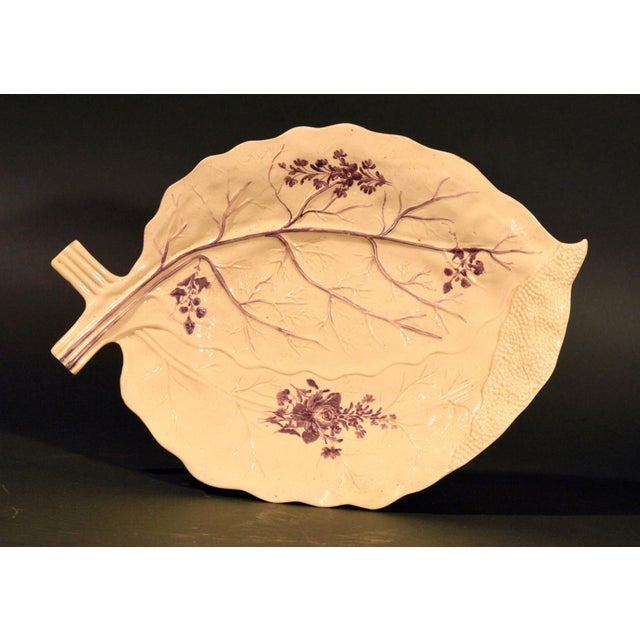
Derbyshire Creamware Large Leaf Dish, Two Overlapping Leaves Painted in Puce, Melbourne Type
English, probably Derbyshire, Melbourne Type, Circa 1785
…
Read more
Derbyshire Creamware Large Leaf Dish, Two Overlapping Leaves Painted in Puce, Melbourne Type
English, probably Derbyshire, Melbourne Type, Circa 1785
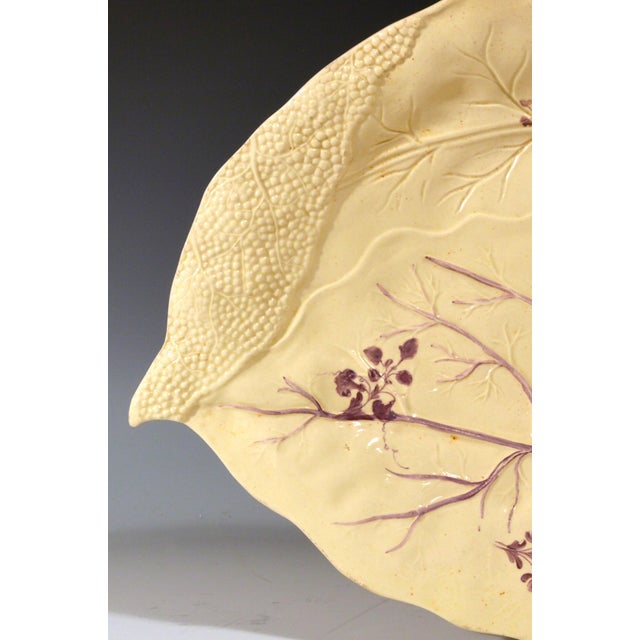
This large creamware dessert dish is press-molded in the form of two overlapping leaves, the nearer leaf lying across the farther so that its wavy edge runs the length of the dish as a raised ridge. The stalk forms the handle: molded with close ribs, it ends in a squared cross-piece as though freshly cut from the plant, and it is picked out with two puce lines that continue across the dish as the midrib of the nearer leaf. Every molded vein of that leaf, down to the finest branching, is traced in puce, while the veins of the farther leaf are left in the cream, so that the painter’s brush separates one leaf from the other. At the tip, a broad band of close-set pebbled bosses crossed by molded veins sets a textured edge against the smooth ground.
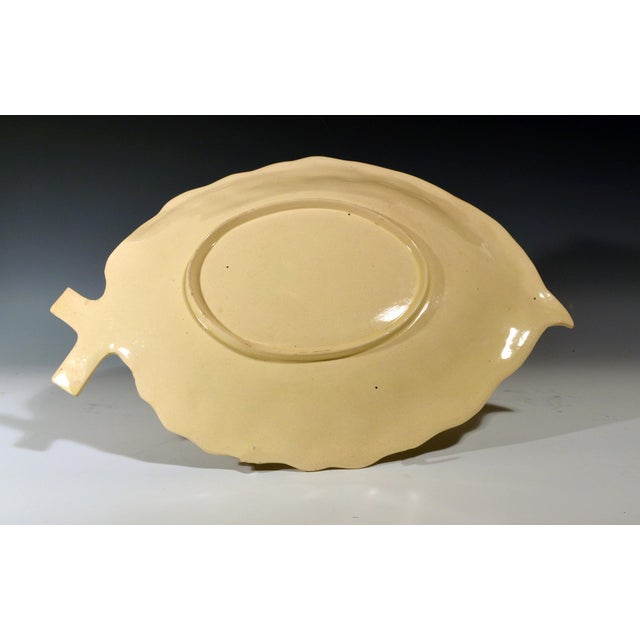
The farther leaf is painted with a large bouquet centered on a full-blown rose among smaller flowers and buds, and the nearer leaf with three smaller sprays, all in puce enamel in the manner of porcelain flower painting en camaïeu. The clear lead glaze has the warm cream tone typical of the body, with scattered iron specks. The underside is glazed throughout and rests on a molded oval foot ring.
Displayed on a stand or hung with a plate hanger, the dish reads as a botanical study in cream and puce. It sits comfortably with other creamware and English porcelain, with botanical prints, and with pale Georgian or country-house furniture, and its scale gives it presence on a sideboard or in a cabinet.
Dimensions
Width: 13¼ inches (33.7 cm)
Depth: 9¼ inches (23.5 cm)
Height: 1¼ inches (3.2 cm)
Marks
Unmarked.
Provenance
Earle D. Vandekar of Knightsbridge
References
Donald Towner, “The Melbourne Pottery,” Transactions of the English Ceramic Circle, vol. 9, pt. 1 (1971), pp. 18–30.
Donald Towner, Creamware (London: Faber & Faber, 1978), chapter on Melbourne.
A. L. Thorpe, “An Unrecorded Derbyshire Pottery,” Derbyshire Archaeological Journal, vol. 78 (1958), pp. 97–102.
H. G. Bradley, ed., Ceramics of Derbyshire 1750–1975: An Illustrated Guide (1978).
T. A. Lockett and P. A. Halfpenny, eds., Creamware and Pearlware: The Fifth Exhibition from the Northern Ceramic Society (Stoke-on-Trent City Museum and Art Gallery, 1986).
Tom Walford, “Cockpit Hill, Derby: Some Evidence from Sherds and Other Places,” in Creamware and Pearlware Re-Examined (English Ceramic Circle, 2007), pp. 179–197.
David Barker, “‘The Usual Classes of Useful Articles’: Staffordshire Ceramics Reconsidered,” Ceramics in America (2001).
Historical Context
Creamware, a refined lead-glazed earthenware developed in Staffordshire around 1750 and brought to commercial success by Josiah Wedgwood from the early 1760s, was being made across England by the later eighteenth century, Derbyshire included. The Derby Pot Works at Cockpit Hill made it from about 1750 until the failure of the Heath family’s bank brought the works down in 1779, its stock being sold the following year. At Melbourne, south of Derby, fragments of unglazed creamware were recovered in 1957 beside a former blast-furnace site and published by A. L. Thorpe, who suggested the small works may have been equipped after the Cockpit Hill failure. Donald Towner later assigned a substantial group of finely molded and painted creamware to Melbourne; the name is still used for that group, although later writers have questioned whether so small a works made wares of that range, and pieces in the manner are therefore described as of Melbourne type.
Leaf-shaped dishes were a staple of the dessert course, set out with fruit and sweetmeats in services that paired naturalistic molding with painted flowers. Monochrome flower painting in puce, borrowed from porcelain, suited creamware well because it leaves the molding to carry the design, and here the painter has used it to separate the two leaves, tracing the veins of one and leaving the other plain.
(Ref: NY08256-mum)
See less
- Dimensions
- 13.25ʺW × 9.25ʺD × 1.24ʺH
- Styles
- Georgian
- Period
- Late 18th Century
- Country of Origin
- United Kingdom
- Item Type
- Vintage, Antique or Pre-owned
- Materials
- Creamware
- Condition
- Good Condition, Original Condition Unaltered, Some Imperfections
- Color
- Cream
Questions about the item?
Returns & Cancellations
Return Policy - All sales are final 48 hours after delivery, unless otherwise specified in the description of the product.
Cancellation Policy - Prior to shipping or local pickup, buyers may cancel an order for up to 48 hours, unless otherwise specified.
Related Collections
- 22K Gold Serving Dishes and Pieces
- Societa Ceramica Italiana Serving Dishes and Pieces
- Byzantine Serving Dishes and Pieces
- Tole Serving Dishes and Pieces
- Studio Pottery Serving Dishes and Pieces
- Melamine Serving Dishes and Pieces
- Fenton Brothers Serving Dishes and Pieces
- Serving Dishes and Pieces in Panama City, FL
- Gold Finish Serving Dishes and Pieces
- Carlsbad Porcelain Serving Dishes and Pieces
- Ralph Lauren Serving Dishes and Pieces
- Cake Stands
- Crystal Serving Dishes and Pieces
- Amber Serving Dishes and Pieces
- Silver Serving Dishes and Pieces
- Carnival Glass Candy Dishes
- Glass Serving Dishes and Pieces
- Chinese Serving Dishes and Pieces
- Limoges, France Serving Dishes and Pieces
- Italian Serving Dishes and Pieces
- Aluminum Serving Dishes and Pieces
- Mid-Century Modern Serving Dishes and Pieces
- Red Wing Pottery Serving Dishes and Pieces
- English Traditional Serving Dishes and Pieces
- French Serving Dishes and Pieces