

Details
Description
Chinese Export Porcelain Bacchus Head Mug after a Derby Original
Circa 1785
This rare Chinese export porcelain mug is modeled …
Read more
Chinese Export Porcelain Bacchus Head Mug after a Derby Original
Circa 1785
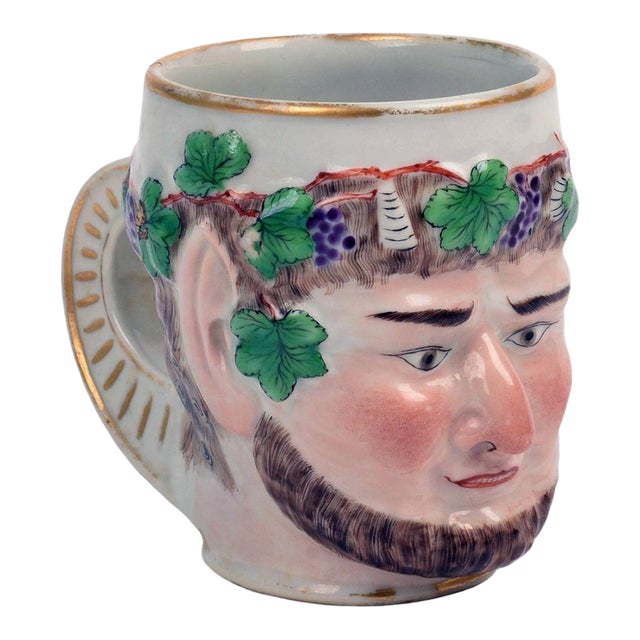
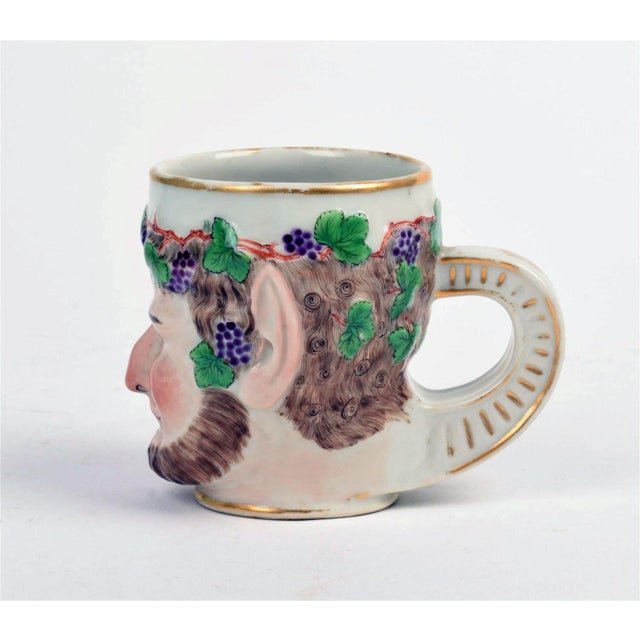
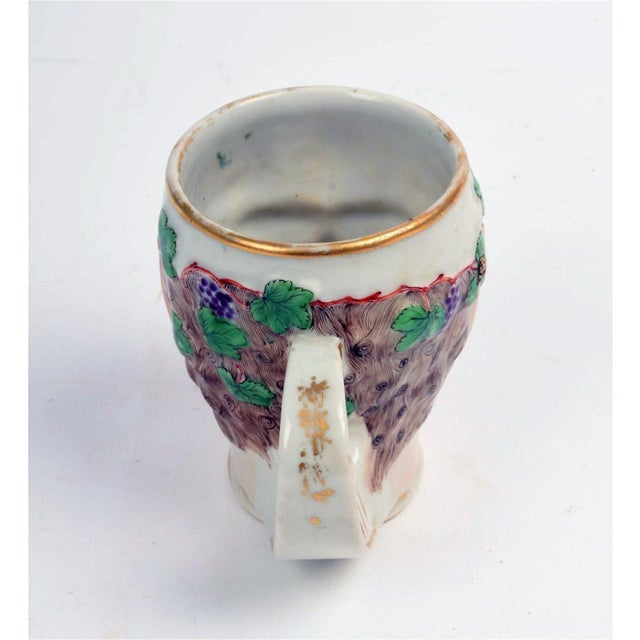
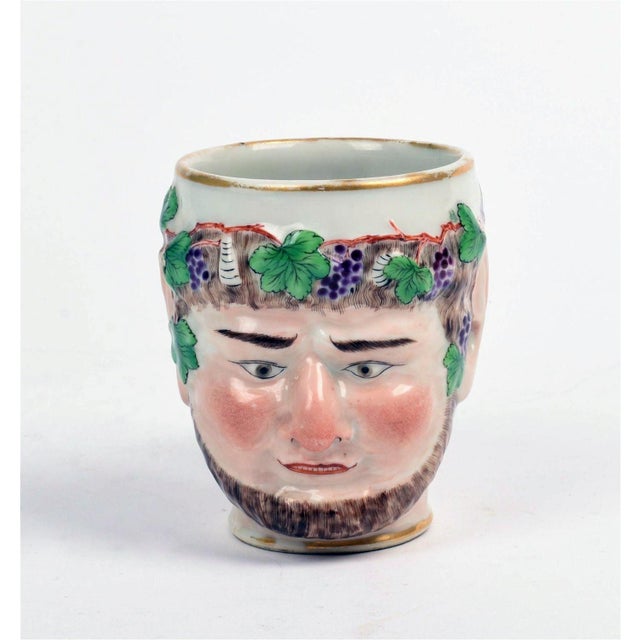
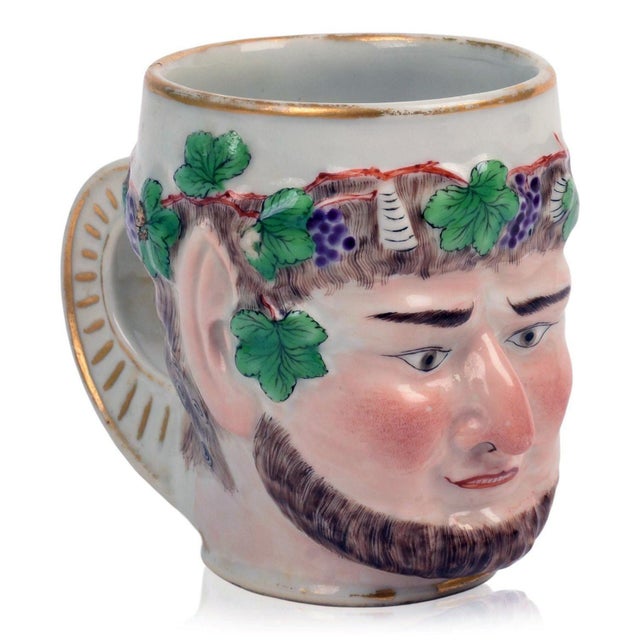
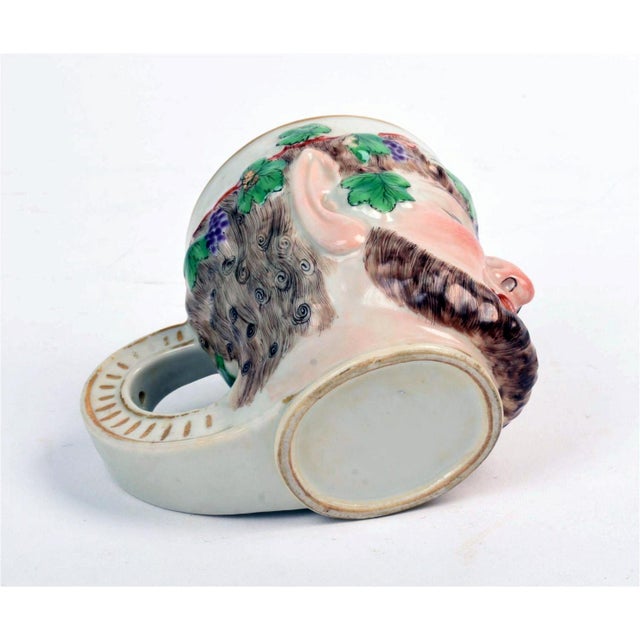
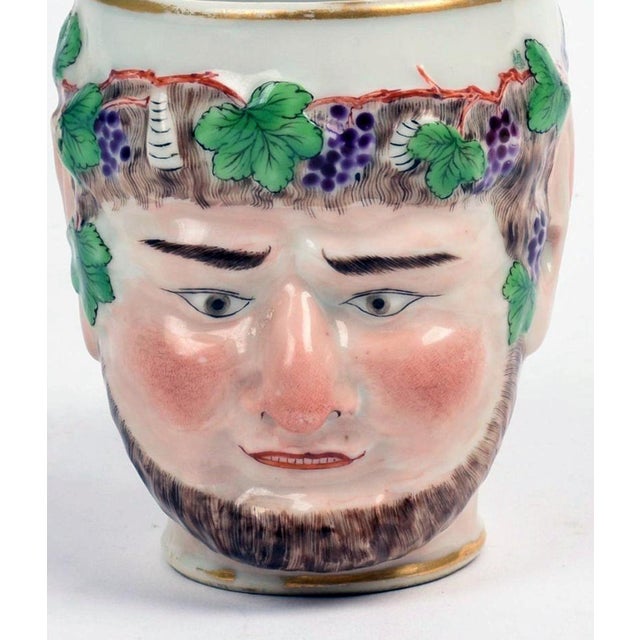
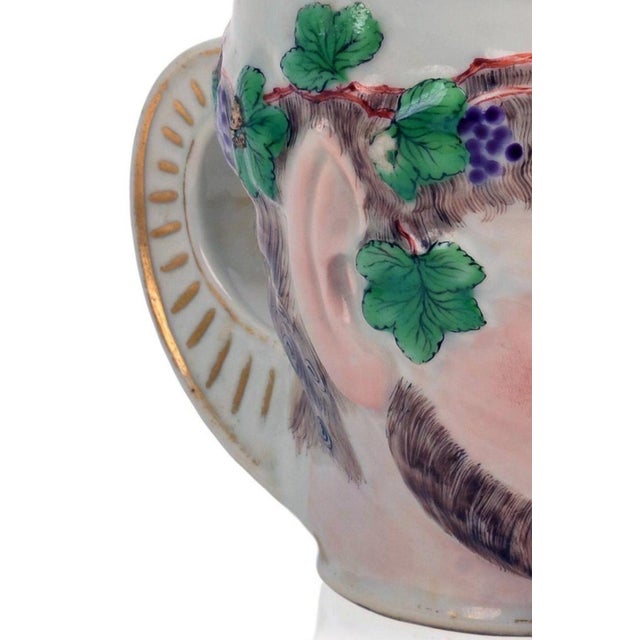
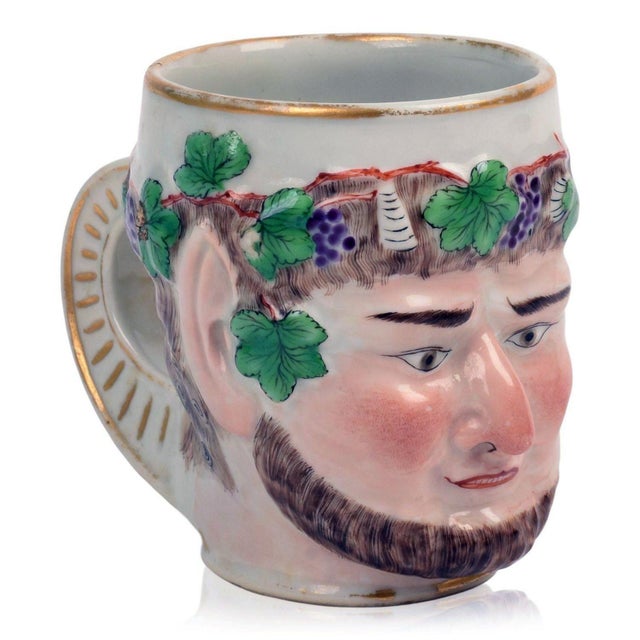
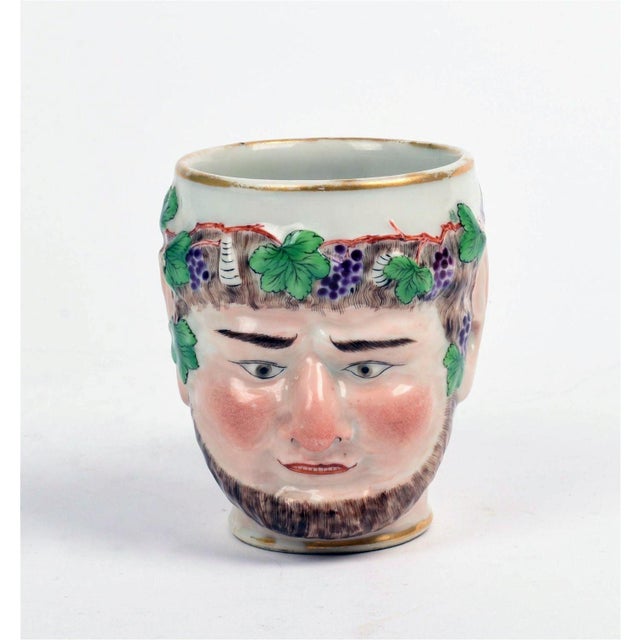
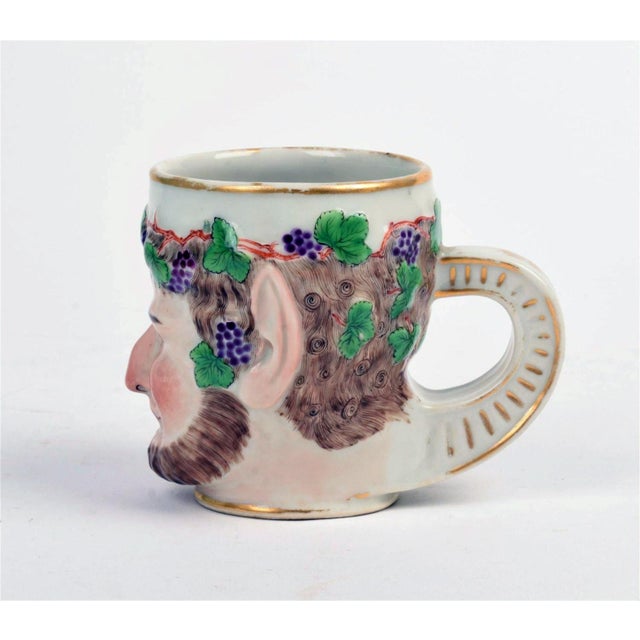
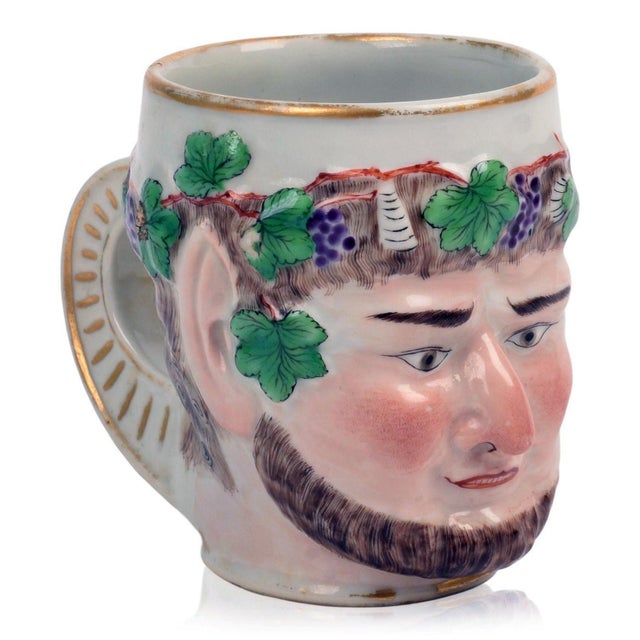
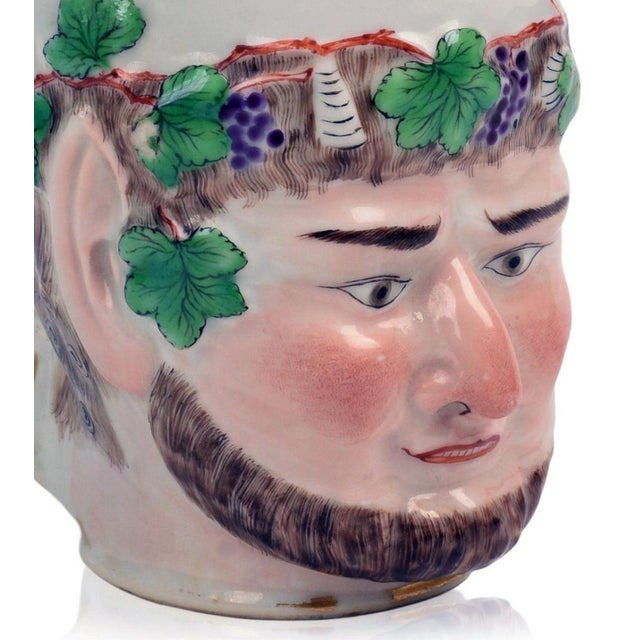
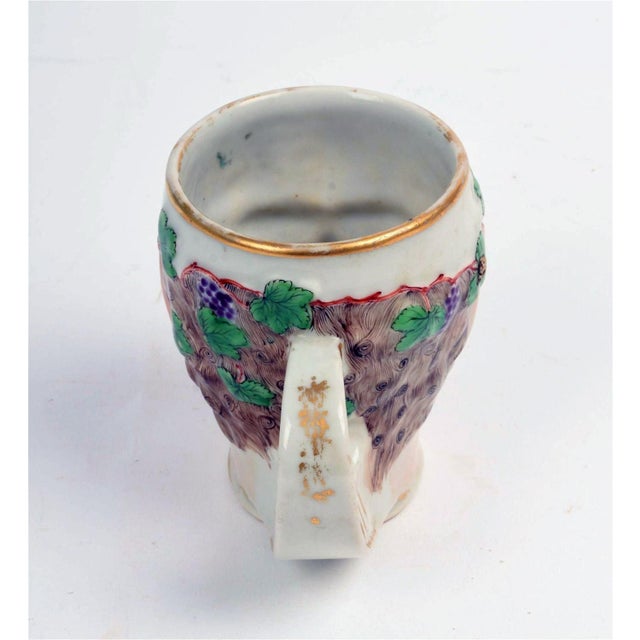
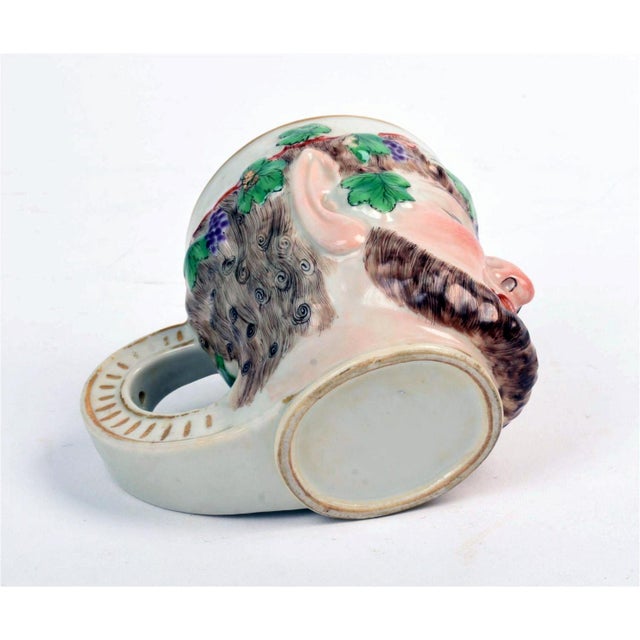
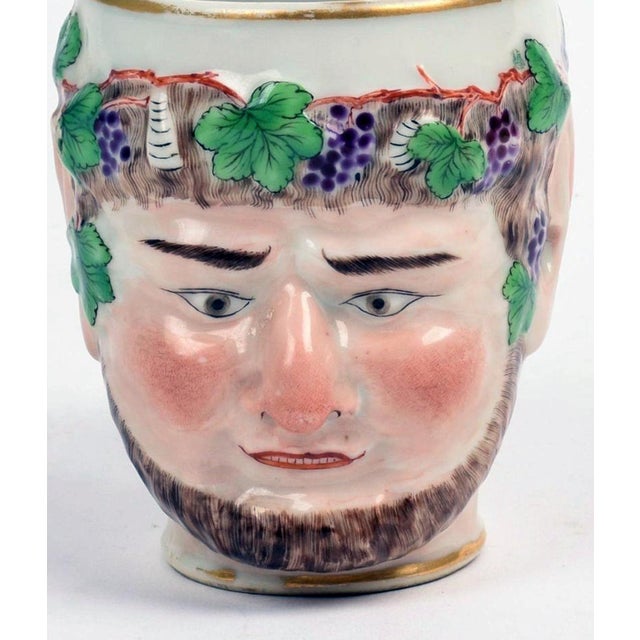
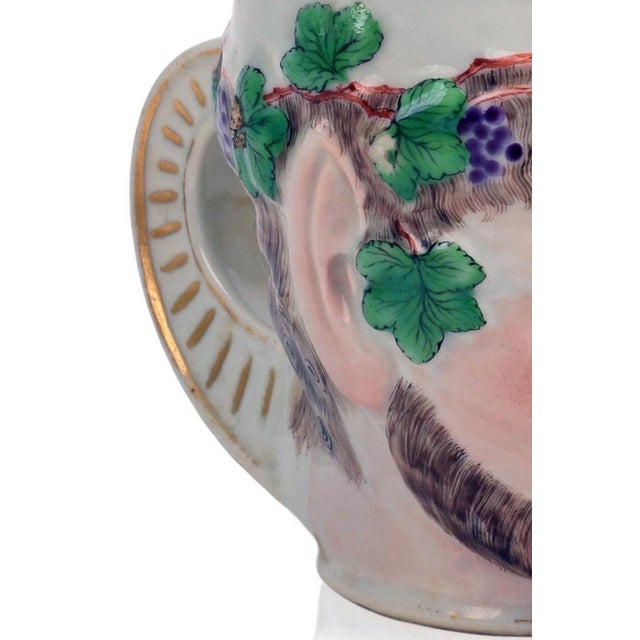
This rare Chinese export porcelain mug is modeled as the head of Bacchus, the Roman god of wine, and copies a soft-paste porcelain original made at the Derby factory of William Duesbury (1725–1786) in the early 1780s. The face is naturalistically enameled in soft flesh tones, with rosy cheeks and nose, gray eyes and a smiling iron-red mouth, while the brows, beard and hair are drawn in fine brown strokes, the hair at the back of the head worked in tight spiral curls. Pointed, faun-like ears frame the face. The god is crowned with a molded wreath of vine leaves enameled in bright green, their veins finely traced in dark gray, with iron-red tendrils and clusters of rich purple grapes, and further leaves and grapes trail through the hair at the sides and back.
The rim and foot are edged in gilding, and the robust flat loop handle is picked out with gilt dashes along each side and gilt sprigs down its spine. The oval base is glazed within an unglazed foot rim. The modeling follows the Derby mug so closely that the Chinese potters must have worked from an actual English example sent out to China, rather than from a print or drawing.
Small in scale but sculptural in presence, the mug reads as a miniature portrait bust on a library shelf or in a cabinet of drinking vessels, and suits a bar or sideboard grouping of wine-themed objects. Its green, purple and gilt palette sits comfortably beside creamware, Chinese export porcelain or Regency giltwood.
Dimensions
Height: 4 inches (10.2 cm)
Width: 5¼ inches (13.3 cm)
Depth: 3½ inches (8.9 cm)
Provenance
Earle D. Vandekar of Knightsbridge
Condition
Excellent antique condition. The enamels remain vibrant, and there are no chips, cracks or restoration. The gilding to the rim and handle is well preserved.
References
William R. Sargent, Treasures of Chinese Export Ceramics from the Peabody Essex Museum (Salem: Peabody Essex Museum, 2012), pp. 472–473, no. 262, tracing the descent of the model from Roman head vessels.
William R. Sargent, The Copeland Collection: Chinese and Japanese Ceramic Figures (Salem: Peabody Essex Museum, 1991), p. 230, a related Bacchus mug in the Copeland Collection.
Elinor Gordon, Collecting Chinese Export Porcelain (New York: Universe Books, 1977), p. 115, pl. 106, an identical example, later sold with her collection at Sotheby’s New York, 2010, lot 29.
David Sanctuary Howard, The Choice of the Private Trader: The Private Market in Chinese Export Porcelain Illustrated from the Hodroff Collection (London: Zwemmer, 1994), p. 195, pl. 226, the related “Neptune” model.
Franklin A. Barrett and Arthur L. Thorpe, Derby Porcelain 1750–1848 (London: Faber and Faber, 1971).
Chazen Museum of Art, University of Wisconsin–Madison, Derby porcelain “Bacchic Mug,” 1780–1805, inventory no. 1991.355, bequest of Mr. and Mrs. John C. Cleaver.
J. Paul Getty Museum, Malibu, lead-glazed head kantharos stamped by Likinnios, Asia Minor, 1st century B.C., inventory no. 83.AE.40.
Historical Context
Head-shaped drinking vessels have a long ancestry. William Sargent traces the type back at least to the first century B.C., citing a mold-made, lead-glazed terracotta cup from Asia Minor in the form of a god’s head wreathed in leaves and stamped with the name of its maker, Likinnios, now in the J. Paul Getty Museum. The Derby factory revived the idea in porcelain in the early 1780s under William Duesbury, and Derby Bacchus mask mugs frequently bear the crowned crossed-batons mark in puce. A closely related Derby model with a crown or cap in place of the wreath has been called “Sailor’s Head,” “Rodney” or “Neptune”; here the vine leaves and grapes leave no doubt that the subject is Bacchus, or Dionysus.
Chinese copies of these English mugs were made for the private trade toward the end of the Qianlong reign and survive in far smaller numbers than the Derby originals. They mark a reversal of the usual traffic in ceramic ideas: after a century in which Europe’s porcelain factories had imitated China, here a Chinese workshop faithfully copied an English model.
(Ref: NY10038-ppux)
See less
- Dimensions
- 5.25ʺW × 3.5ʺD × 4ʺH
- Styles
- Chinese
- Period
- Late 18th Century
- Country of Origin
- China
- Item Type
- Vintage, Antique or Pre-owned
- Materials
- Porcelain
- Condition
- Good Condition, Original Condition Unaltered, Some Imperfections
- Color
- Green
- Condition Notes
- Good condition Good condition less
Questions about the item?
Returns & Cancellations
Return Policy - All sales are final 48 hours after delivery, unless otherwise specified in the description of the product.
Cancellation Policy - Prior to shipping or local pickup, buyers may cancel an order for up to 48 hours, unless otherwise specified.
Related Collections
- Mugs and Cups in Minneapolis
- Classical Roman Mugs and Cups
- Bernardaud Mugs and Cups
- Classical Greek Mugs and Cups
- Mugs and Cups in Lexington, KY
- Chocolate Mugs and Cups
- Peach Mugs and Cups
- Johnson Brothers Mugs and Cups
- Murano Glass Mugs and Cups
- Haviland and Co. Mugs and Cups
- Gold Leaf Mugs and Cups
- Ornamental and Decorative Materials Mugs and Cups
- Qing Mugs and Cups
- Japanese Mugs and Cups
- Metal Mugs and Cups
- Silver Mugs and Cups
- Mid-Century Modern Mugs and Cups
- Bitossi Mugs and Cups
- Otagiri Company Mugs and Cups
- Burgundy Mugs and Cups
- Royal Worcester Mugs and Cups
- Swedish Modern Mugs and Cups
- Dark Green Mugs and Cups
- Mugs and Cups in Cincinnati
- Mugs and Cups in Reno/Lake Tahoe