

Details
Description
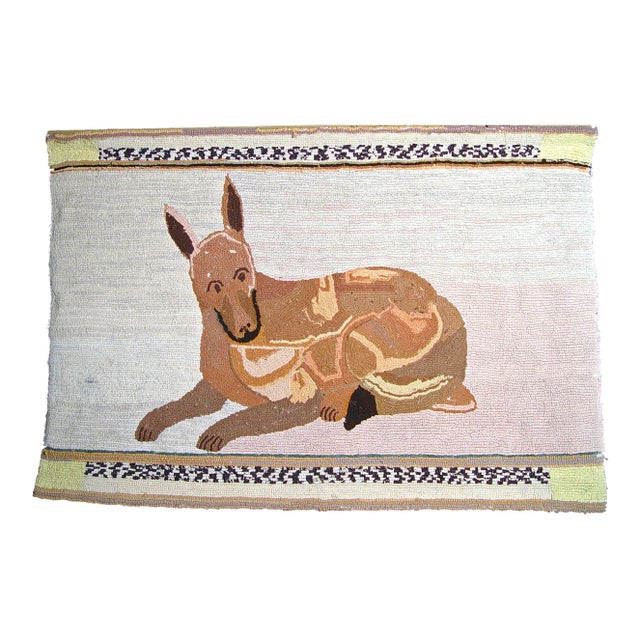
American Folk Art Hooked Rug of a Recumbent Dog, New England, Possibly Vermont
Circa 1920–1940
This hand-hooked wool rug depicts …
Read more
American Folk Art Hooked Rug of a Recumbent Dog, New England, Possibly Vermont
Circa 1920–1940
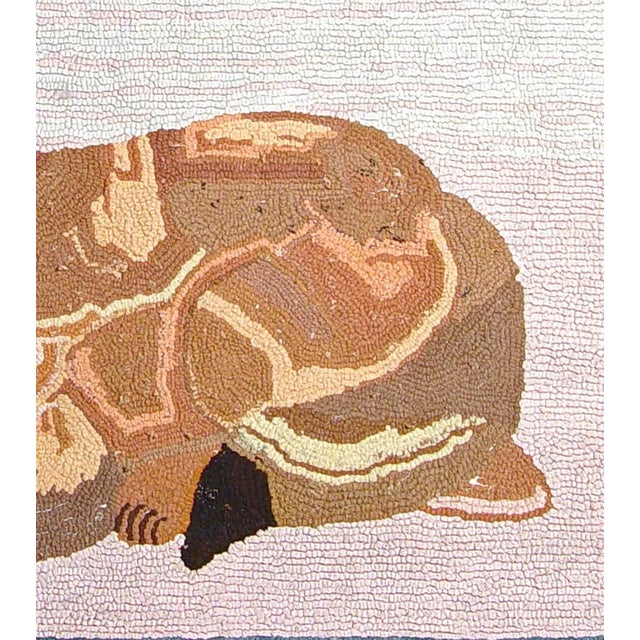
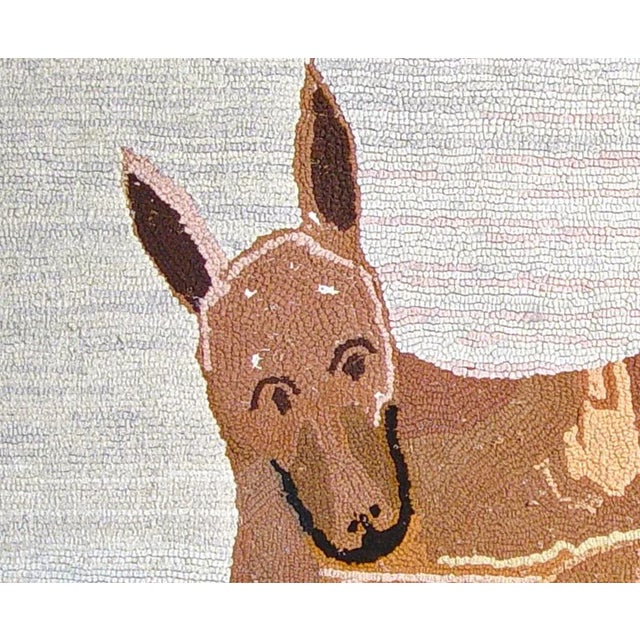
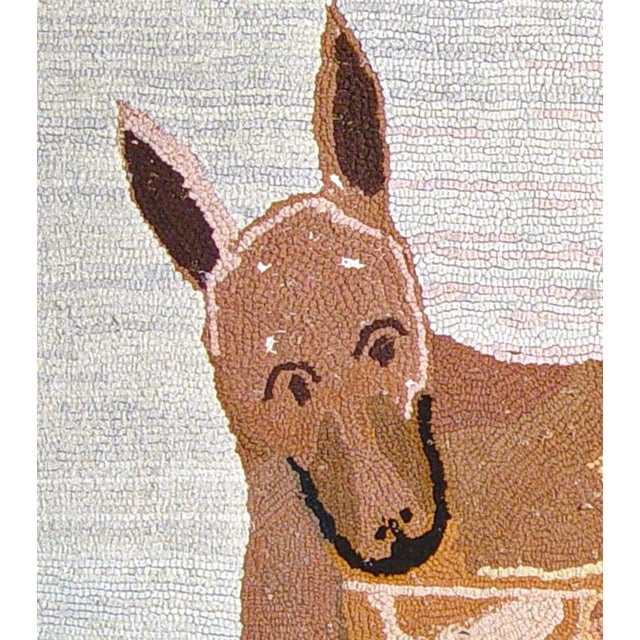
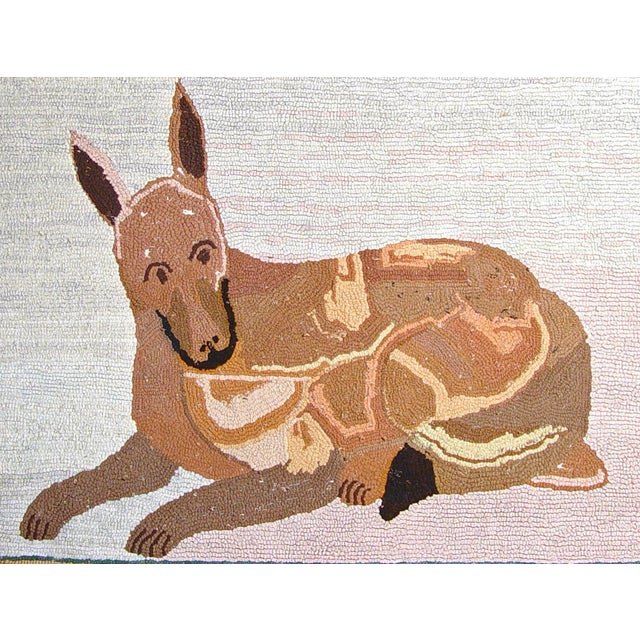
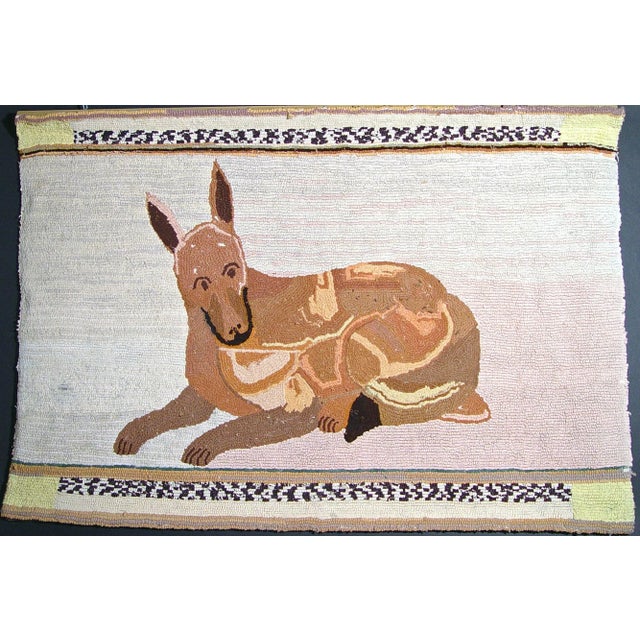
This hand-hooked wool rug depicts a large recumbent dog, its pointed ears erect and head turned as if alert to something beyond the frame, worked in warm ochre, tan, and chocolate brown against a variegated ground shading from pale gray to soft pink. The animal’s form is built up in concentric bands of hooking that suggest volume and musculature in place of anatomical precision, characteristic of freehand folk art design. The pose and long pricked ears recall a shepherd-type or farm dog, though the maker’s naive rendering makes a specific breed impossible to fix with certainty. The field is set between bands of black-and-cream hit-or-miss hooking along the top and bottom edges, each closed at the corners by pale yellow blocks.
Professionally mounted for the wall, the rug hangs as a textile picture. Its soft palette of ochre, gray, and pink sits easily in an entrance hall, study, or mudroom, above a bench or console, and suits a farmhouse, cottage, or collected interior alongside other American folk art.
Dimensions
Width: 39 inches (99.1 cm)
Height: 26½ inches (67.3 cm)
Provenance
Earle D. Vandekar of Knightsbridge.
Condition
The rug has been professionally mounted for wall display. The wool retains good color throughout, with honest wear consistent with its earlier use as a floor covering.
References
Joel and Kate Kopp, American Hooked and Sewn Rugs: Folk Art Underfoot, revised and enlarged edition (New York: E. P. Dutton, 1985; first published 1975).
Historical Context
Hand-hooked rugs are among the most distinctive textile traditions of North America, developed during the nineteenth century among the farming and coastal communities of New England and the Maritime Provinces, where strips of worn woolen cloth were pulled through a foundation of burlap or linen using a simple hand hook. Commercial patterns became widely available after 1868, when Edward Sands Frost of Biddeford, Maine, began selling designs stenciled onto burlap, but freehand rugs designed directly by their makers are particularly prized, offering a personal and often highly individual form of domestic imagery in which a favorite animal, view, or motif was rendered without the benefit of formal artistic training.
The animal subject and hit-or-miss border of the present rug are typical of this vernacular tradition, and pieces of this kind form part of the holdings of institutions such as the Shelburne Museum in Vermont and the American Folk Art Museum in New York.
(Ref: NY02928-kcm-cm)
See less
- Dimensions
- 39ʺW × 0.5ʺD × 26.5ʺH
- Period
- Early 20th Century
- Country of Origin
- United States
- Item Type
- Vintage, Antique or Pre-owned
- Materials
- Cotton
- Condition
- Good Condition, Original Condition Unaltered, Some Imperfections
- Color
- Brown
- Condition Notes
- Good- mounted to be hung Good- mounted to be hung less
Questions about the item?
Returns & Cancellations
Return Policy - All sales are final 48 hours after delivery, unless otherwise specified in the description of the product.
Cancellation Policy - Prior to shipping or local pickup, buyers may cancel an order for up to 48 hours, unless otherwise specified.
Related Collections
- Louis XIII Textile Art
- Loloi Rugs Textile Art
- Kenneth Ludwig Chicago Textile Art
- Resin Textile Art
- Neoclassical Revival Textile Art
- Antique Gold Finish Textile Art
- Classical Roman Textile Art
- Mid-Century Modern Textile Art
- Chinese Textile Art
- Japanese Textile Art
- Tapestry
- Scandinavian Textile Art
- Framed Scarves
- Aubusson Tapestry
- Cardboard Textile Art
- Ralph Lauren Textile Art
- Pablo Picasso Textile Art
- Space Age Textile Art